
Review the key concepts, formulae, and examples before starting your quiz.
🔑Concepts
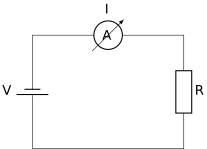
Electric Current () is the rate of flow of electric charges (electrons) through a conductor. It is measured in Amperes () using an Ammeter, which is always connected in series.
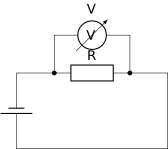
Electric Potential Difference () between two points is the work done to move a unit positive charge from one point to the other. It is measured in Volts () using a Voltmeter connected in parallel.
Ohm's Law states that the current () flowing through a conductor is directly proportional to the potential difference () across its ends, provided temperature remains constant: or .
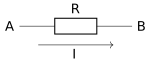
Resistance () is the property of a conductor to resist the flow of charges. Its SI unit is Ohm (). is the resistance of a conductor such that a potential difference of causes a current of to flow.
📐Formulae
💡Examples
Problem 1:
A current of is drawn by a filament of an electric bulb for minutes. Find the amount of electric charge that flows through the circuit.
Solution:
Given: , . Using : .
Explanation:
To find the charge, we multiply the current by the time in seconds. minutes must be converted to seconds for standard SI units.
Problem 2:
How much work is done in moving a charge of across two points having a potential difference of ?
Solution:
Given: , . Using : .
Explanation:
Work done is the product of the potential difference and the amount of charge moved.
Problem 3:
Calculate the number of electrons constituting one Coulomb of charge.
Solution:
Given: , . Using : electrons.
Explanation:
By applying the quantization of charge formula , we find the total number of elementary charges required to sum up to one Coulomb.
Problem 4:
The potential difference between the terminals of an electric heater is when it draws a current of from the source. What current will the heater draw if the potential difference is increased to ?
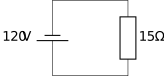
Solution:
Step 1: Find Resistance () using the first case. Given , . According to Ohm's law,
Step 2: Find new current () when . The current through the heater becomes .
Explanation:
Resistance remains constant for the same heater. Since is doubled ( to ), the current also doubles ( to ) following .
Problem 5:
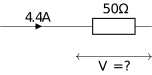
Resistance of an electric iron is . If a current of flows through it, calculate the potential difference between the two terminals of the electric iron.
Solution:
Given: Resistance Current
Using Ohm's Law:
The potential difference is .
Explanation:
By multiplying the flow of charge (current) by the opposition to that flow (resistance), we find the electrical pressure (potential difference) required.