
Electricity - ELECTRIC CURRENT AND CIRCUIT11.1 ELECTRIC CURRENT AND CIRCUIT11.1 ELECTRIC CURRENT AND CIRCUIT11.1 ELECTRIC CURRENT AND CIRCUIT11.1 ELECTRIC CURRENT AND CIRCUIT
Review the key concepts, formulae, and examples before starting your quiz.
🔑Concepts
An electric circuit is a continuous and closed path of an electric current. If the path is broken anywhere (or the switch is turned off), the current stops flowing and the device (like a bulb) does not work.
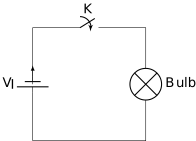
Electric current is expressed by the amount of charge flowing through a particular area in unit time. Conventionally, the direction of electric current is taken as opposite to the direction of the flow of electrons.
The SI unit of electric charge is Coulomb (), which is equivalent to the charge contained in nearly electrons. The SI unit of current is Ampere (), named after Andre-Marie Ampere.
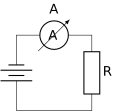
An instrument called ammeter measures electric current in a circuit. It is always connected in series in a circuit through which the current is to be measured.
📐Formulae
💡Examples
Problem 1:
A current of is drawn by a filament of an electric bulb for minutes. Find the amount of electric charge that flows through the circuit.
Solution:
Given: Current , Time . First, convert time to seconds: Using the formula:
Explanation:
To find the charge, we multiply the current by the time in seconds. The resulting unit is Coulombs ().
Problem 2:
Calculate the number of electrons constituting one coulomb of charge.
Solution:
Given: Total charge , Charge of one electron . Using the formula , we find :
Explanation:
By dividing the total charge by the charge of a single electron, we determine that approximately electrons are required to make of charge.
Problem 3:
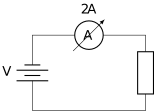
A steady current of flows through a circuit for seconds. If an ammeter is placed in the circuit as shown, determine the total charge that passes through the ammeter during this interval.
Solution:
Given:
Using the formula :
The total charge flowing through the circuit is .
Explanation:
The electric charge is the product of the magnitude of the current and the time for which it flows through the conductor.
Problem 4:
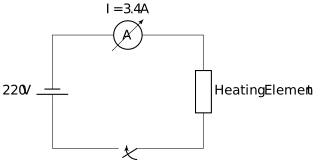
An electric iron draws a current of from a source. If the iron is used for hours, calculate the total electric charge that flows through the heating element. Also, draw the circuit diagram representing this setup with an ammeter and a switch.
Solution:
Given: Current Time hours
Using the formula for electric charge:
The total charge flowing through the element is Coulombs.
Explanation:
To find the total charge, we first convert the time from hours into the SI unit (seconds). By multiplying the steady current by the total time duration, we obtain the total quantity of charge that has passed through the cross-section of the conductor.