
Review the key concepts, formulae, and examples before starting your quiz.
🔑Concepts
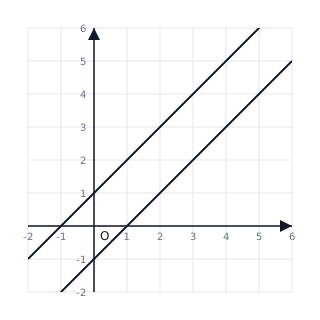
Parallel lines have identical gradients. If two lines and are parallel, their slopes satisfy . Visually, these lines never intersect and remain a constant distance apart.
Perpendicular lines meet at a right angle (). The product of their gradients is , expressed as . One gradient is the negative reciprocal of the other: .
To find the equation of a line passing through that is parallel or perpendicular to a given line, first identify the target gradient , then use the point-gradient formula .
Horizontal lines (gradient ) have the form . Lines perpendicular to them are vertical lines (gradient undefined) which have the form .
📐Formulae
(Gradient formula)
(Gradient-intercept form)
(Condition for Parallel Lines)
or (Condition for Perpendicular Lines)
(Point-gradient form)
💡Examples
Problem 1:
Find the equation of the line parallel to that passes through the point .
Solution:
Explanation:
- Since the lines are parallel, they have the same gradient, so . 2. Use the point in the equation : . 3. Solve for : . 4. Write the final equation: .
Problem 2:
Line L1 has the equation . Find the equation of line L2 which is perpendicular to L1 and passes through the point .
Solution:
Explanation:
- The gradient of L1 is . 2. The perpendicular gradient is the negative reciprocal: . 3. Use with point : . 4. Simplify: .
Problem 3:
Determine if the lines and are parallel, perpendicular, or the same line.
Solution:
The lines are the same (coincident).
Explanation:
- Rearrange both into form. 2. Line 1: . 3. Line 2: . 4. Since both the gradient () and the y-intercept () are identical, they represent the same line.
Problem 4:
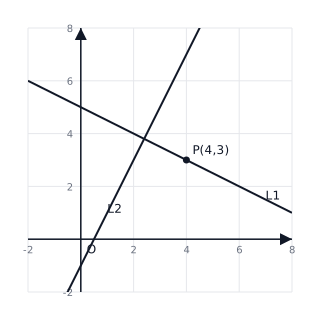
Find the equation of the line that passes through the point and is perpendicular to the line given by the equation . Express your answer in the form .
Solution:
Explanation:
First, identify the gradient of the given line , which is . For perpendicular lines, the product of their gradients is , so the gradient of is the negative reciprocal, . Use the point-slope formula with the coordinates and the new gradient to find the equation of the line, then simplify to the gradient-intercept form.
Problem 5:
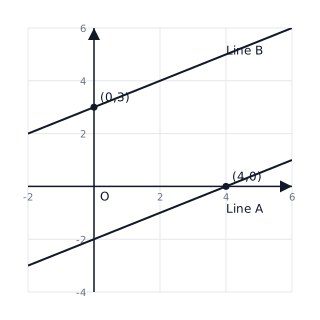
Line passes through the points and . Line is parallel to Line and passes through the point . Find the equation of Line .
Solution:
Explanation:
To find the gradient of Line , use the gradient formula with points and , which gives . Since Line is parallel to Line , it must have the same gradient. Line passes through , which is the -intercept (). Substitute these values into the slope-intercept form.