
Review the key concepts, formulae, and examples before starting your quiz.
🔑Concepts
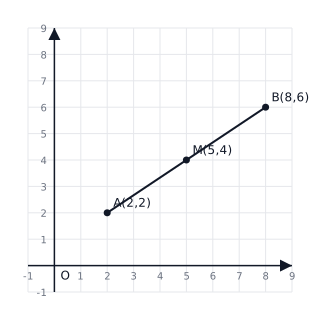
The midpoint of a line segment is the exact center point, calculated by finding the average of the -coordinates and the average of the -coordinates of the endpoints. If the endpoints are and , the midpoint is .
The length of a line segment is the distance between its two endpoints. It is derived from Pythagoras' Theorem: , where the horizontal distance is and the vertical distance is .
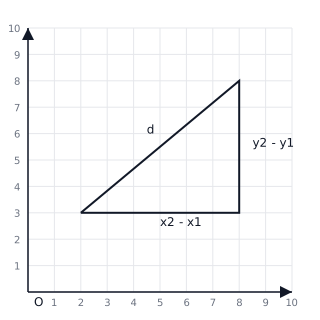
When calculating distances, always square the differences before adding them. Since squares of real numbers are always non-negative, the distance will always be a positive value (or zero if points coincide).
To find an unknown endpoint when given the midpoint and one endpoint, use the midpoint formula in reverse. Let be the known point and be the midpoint. The missing point is found by and .
📐Formulae
Midpoint
Length
💡Examples
Problem 1:
Find the midpoint of the line segment joining the points and .
Solution:
Explanation:
To find the midpoint, add the x-coordinates together and divide by 2, then add the y-coordinates together and divide by 2.
Problem 2:
Calculate the length of the line segment with endpoints and .
Solution:
units
Explanation:
Substitute the coordinates into the distance formula. Subtract the x-values and y-values, square the results, sum them up, and finally take the square root.
Problem 3:
The midpoint of a line segment is . If point is , find the coordinates of point .
Solution:
Let be . . . Point is .
Explanation:
This is a 'reverse' midpoint problem. Set up two separate equations (one for x and one for y) using the midpoint formula and solve for the unknown coordinates of the endpoint.
Problem 4:
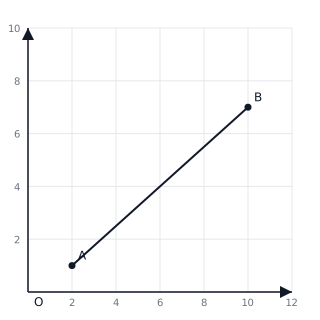
Calculate the length of the line segment where is at and is at .
Solution:
Explanation:
We identify the coordinates and . We calculate the horizontal change (8) and vertical change (6), then apply the distance formula which is effectively the square root of the sum of these squares.
Problem 5:
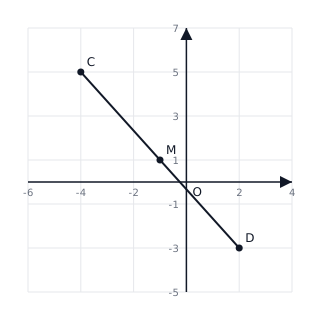
Find the coordinates of the midpoint of the line segment joining the points and .
Solution:
Explanation:
To find the midpoint, we sum the -coordinates and divide by 2, then sum the -coordinates and divide by 2. This gives the average position of the two endpoints.