
Review the key concepts, formulae, and examples before starting your quiz.
🔑Concepts
The gradient (or slope) of a straight line measures its steepness and direction. It is defined as the ratio of the 'rise' (vertical change) to the 'run' (horizontal change) between any two points and on the line:
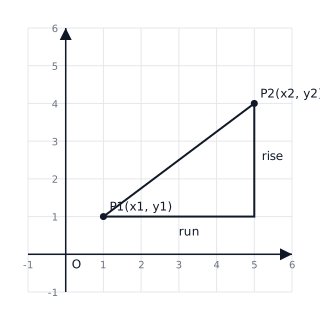
A positive gradient means the line slopes upwards from left to right. A negative gradient means the line slopes downwards from left to right. A horizontal line has a gradient of , while a vertical line has an undefined gradient.
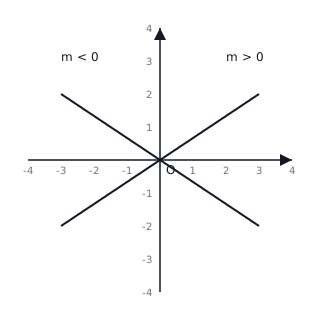
In the equation , represents the gradient and represents the -intercept (where the line crosses the -axis).
Parallel lines have identical gradients (). Perpendicular lines have gradients that are negative reciprocals of each other ().
📐Formulae
💡Examples
Problem 1:
Find the gradient of the line passing through the points and .
Solution:
Explanation:
Label the points as and . Substitute these values into the gradient formula and simplify.
Problem 2:
Determine the gradient of the line given by the equation .
Solution:
. Therefore, .
Explanation:
Rearrange the equation into the standard form . The gradient is the coefficient of once is isolated.
Problem 3:
Line has the equation . Find the gradient of a line that is perpendicular to .
Solution:
, so .
Explanation:
Identify the gradient of the first line (). Since the lines are perpendicular, the product of their gradients must be . Thus, .
Problem 4:
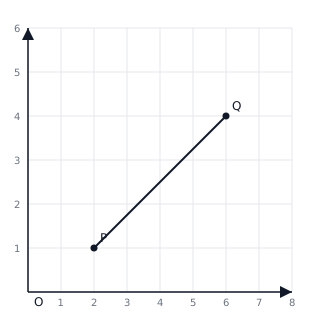
Calculate the gradient of the line segment shown in the coordinate plane that connects the points and .
Solution:
- Identify the coordinates: and .
- Use the gradient formula: .
- Substitute the values: .
- Simplify: or .
Explanation:
The gradient is found by dividing the vertical distance (3 units) by the horizontal distance (4 units) between the two points.
Problem 5:
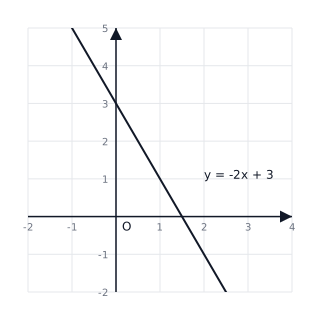
Identify the gradient of the line represented by the function and sketch its direction.
Solution:
- Compare the given equation with the standard form .
- The coefficient of is the gradient, so .
- The negative sign indicates that for every 1 unit move to the right, the line goes down by 2 units.
Explanation:
By putting the linear equation into the form , the gradient is immediately visible as the multiplier of .