
Review the key concepts, formulae, and examples before starting your quiz.
🔑Concepts
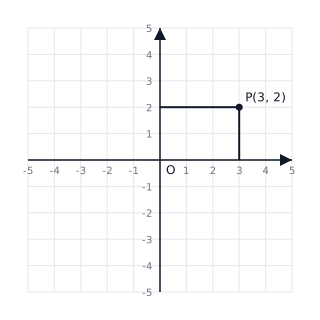
The Cartesian coordinate system uses two perpendicular axes: the horizontal -axis and the vertical -axis. The point where they intersect is called the origin . Any point is represented as , where is the horizontal distance and is the vertical distance from the origin.
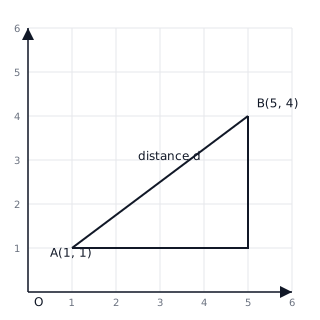
The distance between two points and is derived from Pythagoras' Theorem. By forming a right-angled triangle, the horizontal leg is and the vertical leg is .
The midpoint is the average of the coordinates. It is the point exactly halfway between two endpoints of a line segment.
The gradient (or slope) measures the steepness of a line. It is the ratio of 'rise' (vertical change) over 'run' (horizontal change). A positive gradient slopes upwards from left to right, while a negative gradient slopes downwards.
📐Formulae
💡Examples
Problem 1:
Find the gradient of the line passing through the points and .
Solution:
Given and . Using the gradient formula:
Explanation:
Substitute the coordinates of points and into the gradient formula. Remember that subtracting a negative number results in addition.
Problem 2:
Calculate the distance between the points and .
Solution:
Given and . Using the distance formula: units
Explanation:
Apply the distance formula which is based on the Pythagorean theorem .
Problem 3:
Find the coordinates of the midpoint of the line segment joining and .
Solution:
Given and . Using the midpoint formula:
Explanation:
The midpoint is found by taking the average of the -coordinates and the average of the -coordinates.
Problem 4:
Determine the midpoint of the line segment connecting points and .
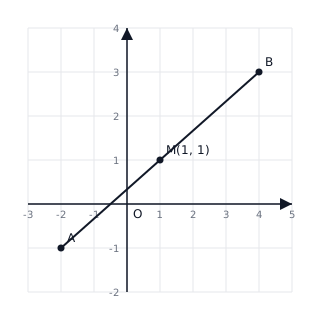
Solution:
- Identify coordinates: and .
- Use the midpoint formula: .
- Calculate: .
Explanation:
The midpoint is found by averaging the x-coordinates and the y-coordinates separately.
Problem 5:
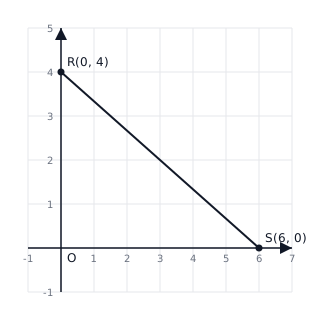
A line passes through and . Calculate the gradient of the line .
Solution:
- Identify coordinates: and .
- Use the gradient formula: .
- Substitute values: .
- Simplify: .
Explanation:
Since the line goes downwards from left to right, the gradient is negative. The vertical drop is units over a horizontal run of units.