
Triangles - Congruence Theorems - Use triangle congruence criteria (SSS, SAS, ASA, RHS, AAS) in proofs
Review the key concepts, formulae, and examples before starting your quiz.
🔑Concepts
Congruence of Triangles: Two triangles are congruent if they are copies of each other and when superimposed, they cover each other exactly. In , the corresponding parts (sides and angles) are equal. This is known as CPCT (Corresponding Parts of Congruent Triangles).
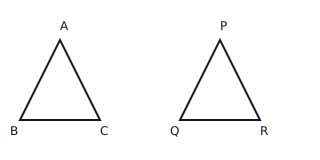
SAS (Side-Angle-Side): Two triangles are congruent if two sides and the included angle of one triangle are equal to the two sides and the included angle of the other triangle.
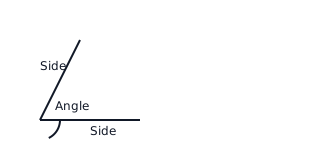
ASA (Angle-Side-Angle) and AAS (Angle-Angle-Side): Two triangles are congruent if two angles and the included side of one are equal to those of the other (ASA). If any two pairs of angles and one pair of corresponding sides are equal, the triangles are congruent (AAS).
SSS (Side-Side-Side): If three sides of one triangle are equal to the three sides of another triangle, then the two triangles are congruent.
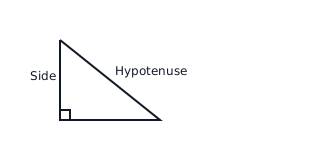
RHS (Right Angle-Hypotenuse-Side): Two right-angled triangles are congruent if the hypotenuse and one side of one triangle are equal to the hypotenuse and one side of the other triangle.
📐Formulae
💡Examples
Problem 1:
In , the bisector of is perpendicular to side . Show that and is isosceles.
Solution:
- In and :
- (Given that bisects )
- (Common side to both triangles)
- (Given )
- Therefore, by the ASA congruence rule.
- So, by CPCT.
- Since two sides of are equal, it is an isosceles triangle.
Explanation:
We use the properties of the angle bisector and the perpendicularity to establish two angles and a shared side, satisfying the ASA criteria. Once congruence is proved, CPCT allows us to equate the main sides of the triangle.
Problem 2:
Line segment is parallel to another line segment . is the mid-point of . Show that and is also the mid-point of .
Solution:
- Consider and :
- (Alternate interior angles as and is the transversal)
- (Given is the mid-point of )
- (Vertically opposite angles)
- Thus, by the ASA congruence rule.
- Consequently, by CPCT.
- Since , is the mid-point of .
Explanation:
The parallel lines provide equal alternate interior angles. Combined with the midpoint definition and vertically opposite angles, we satisfy the ASA rule. CPCT is then used to prove the second part of the problem regarding the other midpoint.
Problem 3:
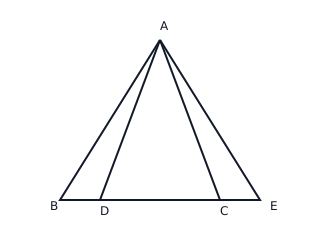
In the given figure, , and . Show that .
Solution:
- Given: .
- Add to both sides: . Therefore, .
- In and :
- (Given)
- (Proved above)
- (Given)
- By SAS congruence criterion, .
- Hence, by CPCT.
Explanation:
The key is to identify the correct pair of triangles ( and ) and prove the equality of the included angle and by adding a common angle to the given equal angles.
Problem 4:
is a quadrilateral in which and . Prove that .
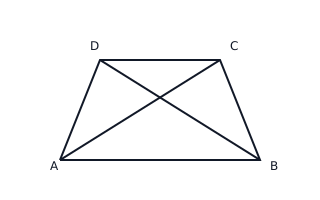
Solution:
- Consider and .
- (Given).
- (Given).
- (Common side).
- Therefore, by SAS congruence criterion.
Explanation:
We use the SAS criterion by identifying two sides and the included angle that are common or given as equal in both triangles sharing the base .