
Triangles - Congruence Theorems - Solve multi-step geometric problems based on triangle theorems
Review the key concepts, formulae, and examples before starting your quiz.
🔑Concepts
The Side-Angle-Side (SAS) Congruence Rule states that if two sides and the included angle of one triangle are equal to two sides and the included angle of another triangle, then the triangles are congruent. This is a primary tool for proving equality of parts in geometric proofs using CPCT (Corresponding Parts of Congruent Triangles).
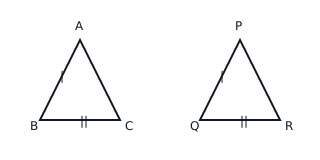
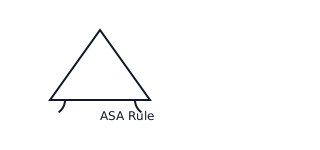
The Angle-Side-Angle (ASA) and Angle-Angle-Side (AAS) rules are used when two angles and one side are given. In ASA, the side must be included between the angles, whereas in AAS, the side is opposite one of the angles. Both criteria imply triangle congruence.
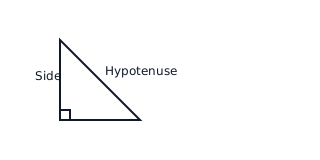
The Right Angle-Hypotenuse-Side (RHS) Congruence Rule is specific to right-angled triangles. It states that if the hypotenuse and one side of one right triangle are equal to the corresponding hypotenuse and side of another right triangle, the triangles are congruent.
In an Isosceles Triangle, angles opposite to equal sides are equal. Conversely, sides opposite to equal angles of a triangle are equal. This property is frequently used in multi-step problems to transition from side equalities to angle equalities and vice versa.
📐Formulae
|AB - BC| < AC
💡Examples
Problem 1:
Is it possible to construct a triangle with sides of lengths , , and ?
Solution:
- According to the Triangle Inequality Theorem, the sum of any two sides must be greater than the third side.
- Let , , and .
- Check the sum of the two smaller sides: .
- Compare this sum to the third side: .
- Since the sum of two sides is not greater than the third side (), a triangle cannot be formed.
Explanation:
To check if a triangle exists, you only need to verify if the sum of the two shortest sides is strictly greater than the longest side.
Problem 2:
In , if and , determine which side of the triangle is the longest and which is the shortest.
Solution:
- First, find the third angle using the Angle Sum Property: .
- Compare the angle measures: , so .
- Use the property that the side opposite the larger angle is longer:
- Side opposite to () is .
- Side opposite to () is .
- Side opposite to () is .
- Therefore, . The longest side is and the shortest side is .
Explanation:
The relative lengths of the sides of a triangle are determined by the measures of the angles opposite to them. Larger angles face longer sides.
Problem 3:
In the given figure, , and . Show that .
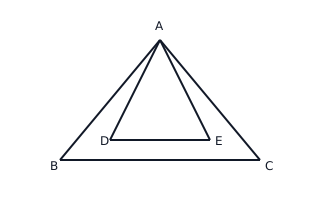
Solution:
- Given: , and .
- Add to both sides of the angle equation:
- Consider and :
- (Given)
- (Proved above)
- (Given)
- Therefore, by congruence rule.
- Hence, by .
Explanation:
To prove , we identify triangles and that contain these segments. We use the given angle equality and add the common angle to establish the equality of the included angles, allowing the use of the SAS rule.
Problem 4:
In , the perpendicular bisector of side is drawn. Show that is an isosceles triangle in which .
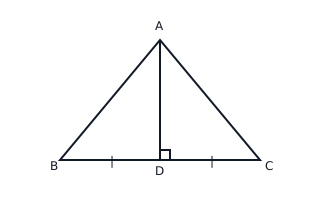
Solution:
- In and :
- (Since is the bisector of )
- (Since is perpendicular to )
- (Common side)
- By SAS congruence criterion, .
- Therefore, by .
- Since two sides are equal, is an isosceles triangle.
Explanation:
By splitting the triangle into two right-angled triangles using the perpendicular bisector, we can prove those two triangles are congruent using SAS. Once proven, the outer sides AB and AC must be equal by CPCT.