
Triangles - Congruence Theorems - Prove triangle properties and evaluate validity of converse statements
Review the key concepts, formulae, and examples before starting your quiz.
🔑Concepts
Congruence of triangles refers to figures that have the same shape and size. Two triangles and are congruent (denoted ) if their corresponding sides and angles are equal.
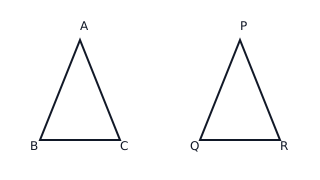
The SAS (Side-Angle-Side) Congruence Rule states that two triangles are congruent if two sides and the included angle of one triangle are equal to the two sides and the included angle of the other triangle.
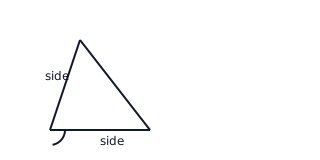
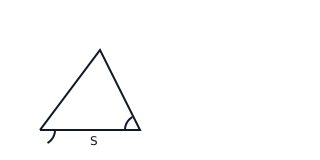
The ASA (Angle-Side-Angle) Rule and AAS (Angle-Angle-Side) Rule: ASA requires the side to be included between two angles, whereas AAS states that congruence holds even if the equal side is not between the two equal angles.
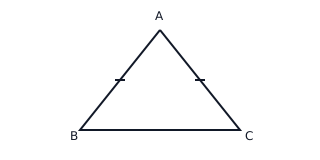
Converse statements in geometry: The converse of a theorem is formed by swapping the hypothesis and the conclusion. For example, if , the converse is: if . Not all converse statements are true, but for isosceles triangles and congruence criteria, they often hold.
📐Formulae
(Triangle Inequality)
💡Examples
Problem 1:
In , the measure of and . Find the measure of .
Solution:
Step 1: Identify the Angle Sum Property, which states that . Step 2: Substitute the known values: . Step 3: Simplify the equation: . Step 4: Subtract from both sides: . Step 5: Therefore, .
Explanation:
This problem uses the fundamental property that all internal angles of any triangle must add up to exactly degrees.
Problem 2:
In an isosceles triangle , and the vertex angle . Find the measures of the base angles and .
Solution:
Step 1: Given , we know from the Isosceles Triangle Theorem that . Let . Step 2: Use the Angle Sum Property: . Step 3: Substitute the values: . Step 4: Combine like terms: . Step 5: Isolate : . Step 6: Solve for : . Step 7: So, and .
Explanation:
The solution relies on two properties: first, that equal sides imply equal opposite angles in a triangle, and second, that all angles must sum to degrees.
Problem 3:
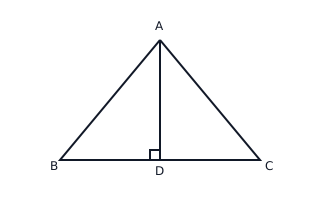
In , is the perpendicular bisector of . Show that is an isosceles triangle in which .
Solution:
In and :
- (Since bisects )
- ()
- (Common side)
Therefore, by SAS rule. By CPCT (Corresponding Parts of Congruent Triangles), . Since two sides are equal, is an isosceles triangle.
Explanation:
To prove a triangle is isosceles, we look for two congruent sub-triangles created by an altitude or median. Here, SAS is applicable because the shared side and the bisected base surround the angle.
Problem 4:
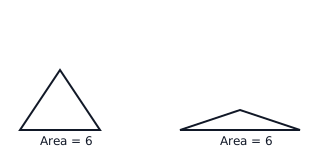
Is the converse of the SSS congruence theorem true? Statement: 'If two triangles have equal areas, they are congruent.' Evaluate the validity.
Solution:
The statement 'If two triangles have equal areas, they are congruent' is FALSE.
Consider with base and height : . Consider with base and height : .
The areas are equal, but the side lengths (dimensions) are different, so the triangles are not congruent.
Explanation:
Congruence requires identical side lengths and angles. Area only requires the product of base and height to be equal. Multiple different triangle shapes can yield the same area value.