
Triangles - Congruence Theorems - Explain triangle rigidity and apply it to stable real-world structures
Review the key concepts, formulae, and examples before starting your quiz.
🔑Concepts
Triangle Rigidity is a unique property where a triangle's shape is fixed if its three side lengths are constant. Unlike quadrilaterals or other polygons, a triangle cannot be deformed without changing the length of its sides. This property is mathematically grounded in the SSS (Side-Side-Side) Congruence Theorem, which states that if three sides of one triangle are equal to the three sides of another, the triangles must be congruent (identical in shape and size).
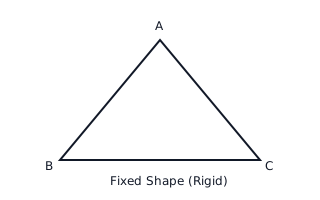
In engineering and architecture, 'triangulation' is the process of adding diagonal members to non-rigid shapes (like rectangles) to create triangles. This makes the structure stable because it prevents the joints from shifting. For a polygon with sides to become rigid, it must be divided into triangles using diagonals.
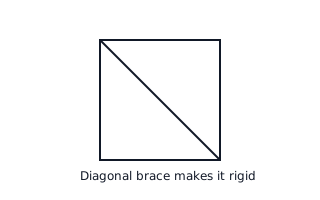
The stability of structures like bridges, electricity pylons, and cranes relies on the fact that once the three side lengths of a triangle are set, the angles are also fixed. This ensures that the structure can withstand external forces without collapsing or folding.
Application of SSS Congruence: When two structures share the same three side lengths, they are exactly the same shape. This allows for the mass production of identical, stable components in modular construction.
📐Formulae
💡Examples
Problem 1:
A square gate has four sides of equal length. However, it is 'wobbly' and loses its shape. An engineer adds a metal bar along the diagonal . Explain using congruence theorems why the gate is now stable.
Solution:
- Initially, the square can be deformed because even if sides are fixed, the angles can change.
- When diagonal is added, the gate is divided into two triangles: and .
- In , the side lengths and are fixed. According to the congruence rule, the angles and are now fixed and cannot change.
- Similarly, in , the angles are fixed.
- Since the angles are fixed, the frame cannot 'hinge' or deform, making the structure rigid.
Explanation:
This demonstrates the application of congruence in structural engineering. By forming triangles, we ensure that the angles of the structure cannot change without the metal bars physically breaking or stretching.
Problem 2:
In a triangular roof truss, two identical support beams and meet at the top . A horizontal beam connects the base. If a vertical pillar is constructed such that is the midpoint of , prove that the two sides of the truss are congruent.
Solution:
Given: (Identical beams) and ( is the midpoint of ). In and :
- (Given)
- (Given, since is the midpoint)
- (Common side) Therefore, by congruence criterion. By , . Since is a straight line:
Explanation:
This proof shows that a symmetrical triangular truss naturally creates right-angled supports, contributing to the balance and stability of the roof structure.
Problem 3:
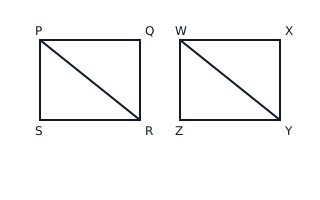
A simple wooden fence panel is in the shape of a rectangle . To prevent it from sagging, a diagonal wooden plank is nailed across it. If m and m, and another identical panel is built with a diagonal such that , , and , prove that the two panels are congruent using the SSS theorem and explain why they are now stable.
Solution:
In and :
- (Given)
- (Given)
- (Given)
By the SSS Congruence Rule, .
Since the triangles are congruent, their corresponding angles are fixed (CPCT). Because the diagonal divides the rectangle into two triangles whose side lengths cannot change, the angles at the joints are locked. This prevents the rectangle from shifting into a parallelogram shape, making the structure rigid.
Explanation:
This example demonstrates how a non-rigid quadrilateral is transformed into two rigid triangles through a diagonal, utilizing the SSS congruence property to ensure stability.
Problem 4:
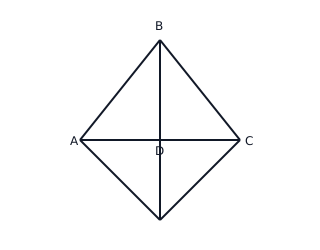
An electricity pylon uses triangular bracing. In one section, two triangles and are formed by a central brace . If and , prove that the brace bisects the angle , and explain how this symmetrical triangulation contributes to the pylon's strength.
Solution:
In and :
- (Given)
- (Given)
- (Common side)
Therefore, by SSS Congruence Rule.
Since the triangles are congruent, (by CPCT). Thus, bisects .
In terms of strength, because and form triangles with fixed side lengths, the entire structure is rigid. The symmetry ensures that loads (like wind or the weight of cables) are distributed equally on both sides of the pylon.
Explanation:
This shows that SSS congruence not only proves equality of parts but also justifies the use of symmetry in heavy-duty engineering structures for load distribution.