
Review the key concepts, formulae, and examples before starting your quiz.
🔑Concepts
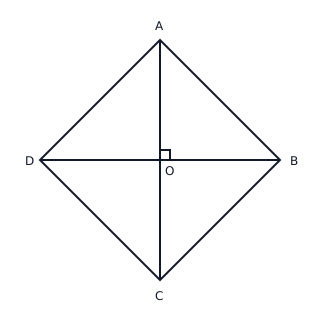
A Rhombus is a parallelogram where all sides are of equal length. Its diagonals are perpendicular bisectors of each other, meaning they intersect at and divide each other into two equal halves.
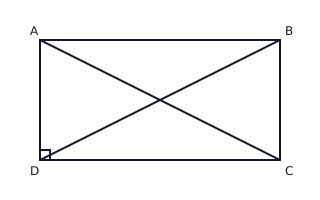
A Rectangle is a parallelogram with four right angles (). Because it is a parallelogram, opposite sides are equal. Crucially, the diagonals of a rectangle are equal in length ().
A Square is a special parallelogram that is both a rhombus and a rectangle. It has four equal sides and four right angles. Its diagonals are equal and bisect each other at .
Relationship Hierarchy: Every Square is a Rectangle and a Rhombus. Every Rectangle and Rhombus is a Parallelogram. Every Parallelogram is a Quadrilateral.
📐Formulae
Perimeter of a Rhombus or Square: (where is the side length)
Area of a Rhombus: (where and are the lengths of the diagonals)
Perimeter of a Rectangle: (where is length and is breadth)
Area of a Rectangle:
Diagonal of a Rectangle: (derived from Pythagoras Theorem)
Area of a Square: or (where is the diagonal)
💡Examples
Problem 1:
In a rhombus , the diagonals and intersect at point . If cm and cm, find the length of the side .
Solution:
- In a rhombus, diagonals bisect each other at . Therefore, is a right-angled triangle with .
- Using Pythagoras Theorem in :
- cm.
Explanation:
Since the diagonals of a rhombus are perpendicular bisectors, they create four right-angled triangles at the intersection. We use the legs of one triangle ( and ) to find the hypotenuse, which is the side of the rhombus.
Problem 2:
is a rectangle. Its diagonals meet at . Find if and .
Solution:
- In a rectangle, the diagonals are equal in length ().
- Since diagonals bisect each other, their halves are also equal. Therefore, .
- Set up the equation: .
- Subtract from both sides: .
- Subtract from both sides: .
Explanation:
We use the property that diagonals of a rectangle are equal and bisect each other, which implies that the distance from the center to any vertex is the same.
Problem 3:
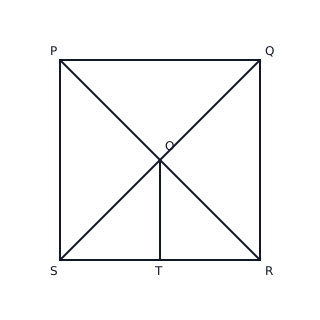
In the given square , find the value of where is the intersection of diagonals and is a point on such that .
Solution:
Explanation:
The diagonals of a square are perpendicular. Since the triangle formed by the intersection point and one side is isosceles, the altitude drawn to that side bisects the angle at the center.
Problem 4:
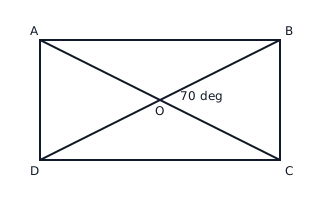
In rectangle , the diagonals and meet at . If , find .
Solution:
Explanation:
We use the property that diagonals of a rectangle are equal and bisect each other to identify isosceles triangles. Then, we apply the Angle Sum Property of a triangle.