
Review the key concepts, formulae, and examples before starting your quiz.
🔑Concepts
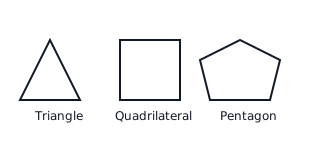
A polygon is a simple closed curve made up of only line segments. Polygons are classified based on the number of sides (or vertices) they have: Triangle (3), Quadrilateral (4), Pentagon (5), Hexagon (6), and so on.
A diagonal is a line segment connecting two non-consecutive vertices of a polygon. For a polygon with sides, the number of diagonals is given by .
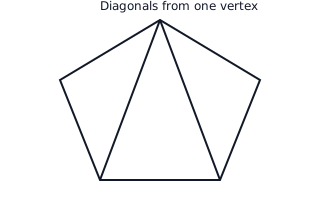
Polygons are Convex if all diagonals lie in the interior, or Concave if at least one diagonal (or part of it) lies in the exterior. In a convex polygon, every interior angle is less than .

A Regular Polygon is both equiangular (all angles equal) and equilateral (all sides equal). Examples include equilateral triangles and squares. Irregular polygons do not have all sides and angles equal.
📐Formulae
Sum of the interior angles of a polygon =
Sum of the exterior angles of any polygon =
Number of diagonals in a polygon with sides =
Measure of each interior angle of a regular -sided polygon =
Measure of each exterior angle of a regular -sided polygon =
💡Examples
Problem 1:
Find the number of sides of a regular polygon if each exterior angle has a measure of .
Solution:
- We know that the sum of all exterior angles of any polygon is .
- For a regular polygon, all exterior angles are equal.
- Let the number of sides be .
- The formula for the number of sides is .
- Substitute the given value: .
Explanation:
Since the polygon is regular, we divide the total sum of exterior angles () by the measure of a single exterior angle to find the number of vertices, which corresponds to the number of sides.
Problem 2:
Find the value of the unknown angle in a quadrilateral if the other three angles are and .
Solution:
- The sum of the interior angles of a quadrilateral is .
- Set up the equation: .
- Combine the known angles: .
- Subtract from both sides: .
Explanation:
This solution uses the angle sum property of quadrilaterals, which dictates that the four interior angles must always total regardless of the shape's specific dimensions.
Problem 3:
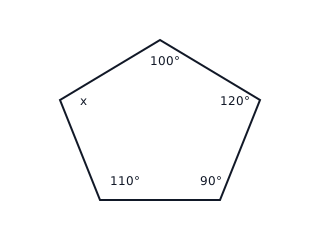
Find the value of in the given pentagon where four interior angles are and .
Solution:
The sum of interior angles of a pentagon () is: Sum Summing the given angles:
Explanation:
First, we calculate the total sum of interior angles for a 5-sided polygon using the formula . Then, we subtract the sum of the four known angles from the total to find the missing angle.
Problem 4:
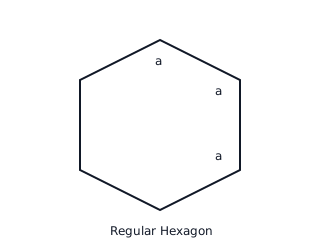
Calculate the measure of each interior angle of a regular hexagon.
Solution:
A regular hexagon has sides. Sum of interior angles Since it is a regular polygon, all interior angles are equal. Each interior angle
Explanation:
For any regular polygon, each interior angle is the total sum of angles divided by the number of sides. For a hexagon, this is .