
Review the key concepts, formulae, and examples before starting your quiz.
🔑Concepts
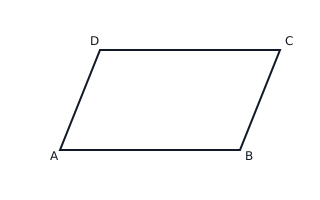
A Parallelogram is a quadrilateral where both pairs of opposite sides are parallel. Key properties include: opposite sides are equal, opposite angles are equal, and diagonals bisect each other.
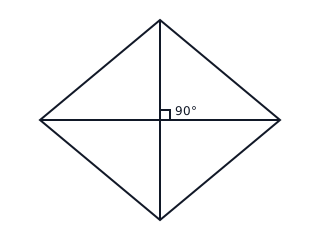
A Rhombus is a special parallelogram where all four sides are equal in length. Crucially, its diagonals bisect each other at right angles ().
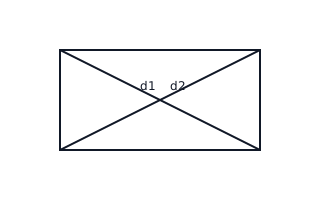
A Rectangle is a parallelogram with four right angles. Its diagonals are equal in length and bisect each other.
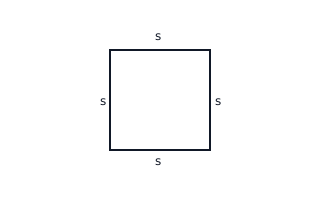
A Square is a regular quadrilateral. It has four equal sides and four right angles. It possesses all properties of a rectangle, rhombus, and parallelogram.
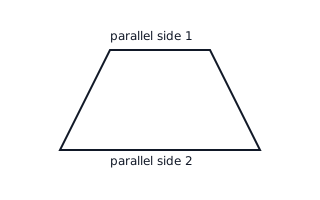
A Trapezium has exactly one pair of parallel sides. If the non-parallel sides are equal, it is called an Isosceles Trapezium.
A Kite has two pairs of equal-length sides that are adjacent to each other. Its diagonals are perpendicular, and one diagonal bisects the other.
📐Formulae
Sum of interior angles of a quadrilateral =
Sum of exterior angles of any convex quadrilateral =
Number of diagonals in a quadrilateral =
Area of a Parallelogram =
Area of a Rhombus = (where are diagonals)
Area of a Trapezium = (where are parallel sides and is the height)
Perimeter of a Quadrilateral =
💡Examples
Problem 1:
In a parallelogram , the measure of is . Find the measures of the remaining angles , , and .
Solution:
- In a parallelogram, adjacent angles are supplementary. Therefore, .
- Substitute the given value: .
- Opposite angles of a parallelogram are equal. Therefore, and .
Explanation:
This solution uses the property that consecutive angles in a parallelogram sum to and opposite angles are congruent.
Problem 2:
The diagonals of a rhombus are cm and cm. Find the length of each side of the rhombus.
Solution:
- Let the diagonals be cm and cm. They bisect each other at .
- The half-lengths of the diagonals are cm and cm.
- These half-lengths form the legs of a right-angled triangle where the side of the rhombus () is the hypotenuse.
- Using Pythagoras theorem: .
- cm.
Explanation:
Since diagonals of a rhombus are perpendicular bisectors, we can use the Pythagorean theorem on one of the four internal right-angled triangles to find the side length.
Problem 3:
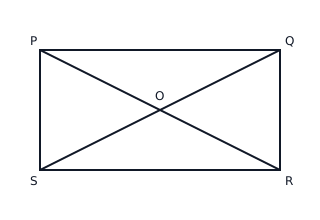
In the given rectangle , the diagonals intersect at point . If and , find the value of .
Solution:
- In a rectangle, diagonals are equal in length and bisect each other.
- This means .
- Since diagonals bisect each other, and .
- Therefore, .
- Equating the expressions: .
- Subtracting from both sides: .
- Subtracting from both sides: .
Explanation:
Because the diagonals of a rectangle are equal and bisect each other, the segments from the center to any vertex are equal in length. This allows us to set the two algebraic expressions for the segments equal to each other and solve for .
Problem 4:
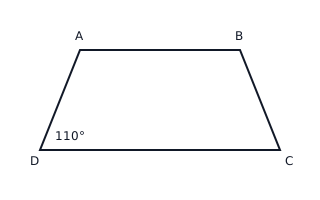
In the isosceles trapezium where and , if , find the measure of .
Solution:
- In a trapezium, adjacent angles between parallel lines are supplementary (they add up to ).
- Since , .
- Given , we have .
- Therefore, .
Explanation:
Consecutive interior angles formed by a transversal (the non-parallel side ) intersecting two parallel lines ( and ) are always supplementary.