
Review the key concepts, formulae, and examples before starting your quiz.
🔑Concepts
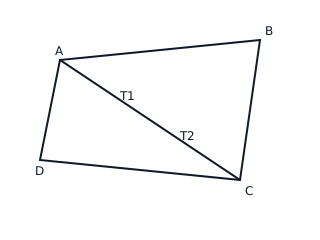
The Angle Sum Property states that the sum of all interior angles of a quadrilateral is exactly . This can be visualized by dividing the quadrilateral into two triangles using a diagonal; since each triangle's angles sum to , the total sum is .
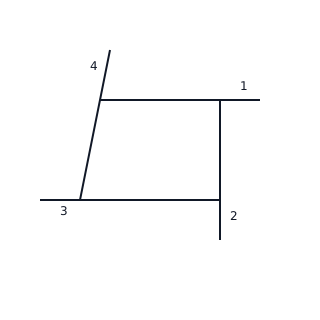
In a convex polygon, the sum of the measures of the exterior angles (one at each vertex) is always , regardless of the number of sides. For a quadrilateral, .
The interior angle sum of a polygon with sides is calculated using the formula . For a quadrilateral, , so .
For a regular polygon (where all sides and angles are equal), each interior angle can be found by dividing the total sum by the number of sides: .
📐Formulae
Sum of interior angles of a quadrilateral:
General sum of interior angles for sides:
Sum of exterior angles of any convex polygon:
Measure of each interior angle of a regular -sided polygon:
Measure of each exterior angle of a regular -sided polygon:
💡Examples
Problem 1:
Three angles of a quadrilateral are , , and . Find the measure of the fourth angle.
Solution:
- Let the measure of the fourth angle be .
- According to the angle sum property of a quadrilateral: .
- Add the known angles: .
- Subtract from both sides: .
- .
Explanation:
We use the property that the sum of all four interior angles must equal . By setting up a simple linear equation with the unknown angle , we can solve for its value.
Problem 2:
The angles of a quadrilateral are in the ratio . Find the measure of each angle.
Solution:
- Let the common ratio factor be . The four angles are , , , and .
- Using the angle sum property: .
- Combine like terms: .
- Solve for : .
- Calculate each angle:
- First angle:
- Second angle:
- Third angle:
- Fourth angle: .
Explanation:
When angles are given in a ratio, we represent them as multiples of a variable . We then sum these expressions and set them equal to to find the value of , which allows us to determine the actual measure of each angle.
Problem 3:
In the given quadrilateral , , , , and . Find the value of and the measures of angles and .
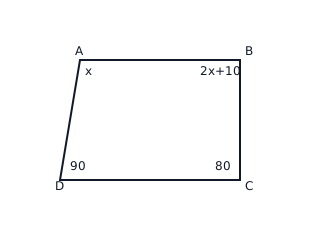
Solution:
- According to the Angle Sum Property:
- Substitute the given values:
- Combine like terms:
- Subtract from both sides:
- Divide by :
- Calculate the angles:
Explanation:
We use the property that all interior angles of a quadrilateral add up to 360 degrees. By setting up a linear equation with the unknown variable , we solve for and kemudian substitute it back into the expressions for the individual angles.
Problem 4:
Find the value of in the quadrilateral where three exterior angles are , , and as shown.
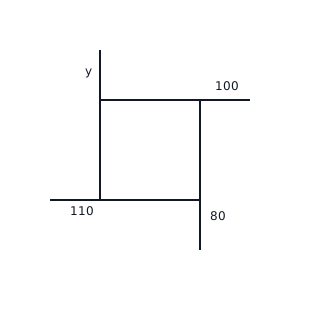
Solution:
- The sum of exterior angles of any convex polygon is .
- Let the fourth exterior angle be .
- Therefore, the value of is .
Explanation:
Since the sum of exterior angles is always constant at 360 degrees for any polygon, we simply subtract the sum of the known exterior angles from 360 to find the missing one.