
Review the key concepts, formulae, and examples before starting your quiz.
🔑Concepts
A parallelogram is a quadrilateral where opposite sides are parallel and equal in length. In parallelogram , side and . Also, and .
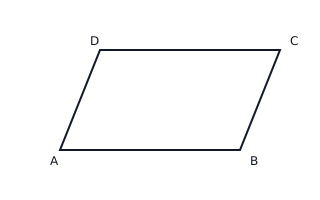
The opposite angles of a parallelogram are equal. For example, and .
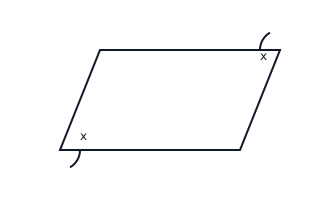
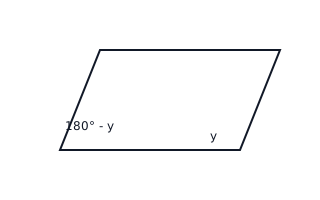
Any two adjacent angles in a parallelogram are supplementary, meaning their sum is . So, , , etc.
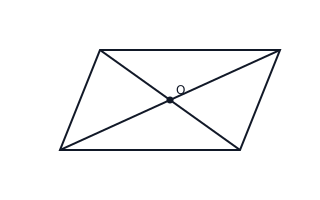
The diagonals of a parallelogram bisect each other. This means the point where the diagonals intersect is the midpoint of both diagonals.
📐Formulae
Perimeter of a parallelogram = , where and are the lengths of adjacent sides.
Area of a parallelogram =
Sum of adjacent angles:
Opposite sides:
Opposite angles: and
💡Examples
Problem 1:
In a parallelogram , the measure of . Find the measures of the remaining three angles , , and .
Solution:
Step 1: Use the property that opposite angles are equal. Therefore, . Step 2: Use the property that adjacent angles are supplementary. So, . Step 3: Substitute the value of : . Step 4: Use the opposite angle property again for . .
Explanation:
We applied two fundamental properties: opposite angles are equal and adjacent angles sum to to find all unknown interior angles.
Problem 2:
The perimeter of a parallelogram is cm. If the longer side measures cm, find the length of the shorter side.
Solution:
Step 1: Let the longer side be cm and the shorter side be . Step 2: Use the perimeter formula: . Step 3: Substitute the known values: . Step 4: Divide by : . Step 5: Solve for : cm.
Explanation:
Since opposite sides of a parallelogram are equal, the perimeter is simply twice the sum of two adjacent sides. We used the algebraic equation to solve for the missing side.
Problem 3:
In the parallelogram , the diagonals and intersect at point . If cm and cm, find the lengths of and .
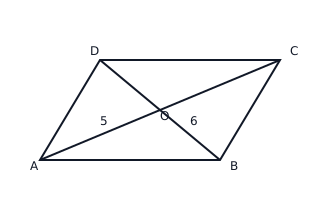
Solution:
- We know that the diagonals of a parallelogram bisect each other.
- Therefore, and .
- Given cm, then cm.
- Given cm, then cm.
Explanation:
Since diagonals bisect each other, the intersection point is the midpoint. Thus, each diagonal is split into two equal segments.
Problem 4:
In parallelogram , the lengths are given as units and is more than . If is the point where diagonals intersect, find .
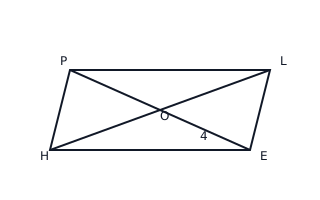
Solution:
- In parallelogram , diagonals and bisect each other at .
- units.
- Given , so units.
- Since is the midpoint of , units.
Explanation:
We use the property that diagonals bisect each other to find the full length of one diagonal, then use the given relationship to find the other, and finally halve it to find the segment length.