
Review the key concepts, formulae, and examples before starting your quiz.
🔑Concepts
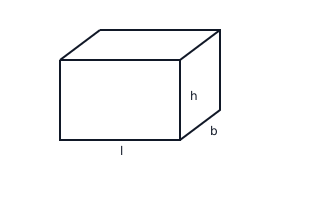
Volume refers to the amount of space occupied by a three-dimensional object. For a cuboid, it is calculated as the product of its length (), breadth (), and height ().
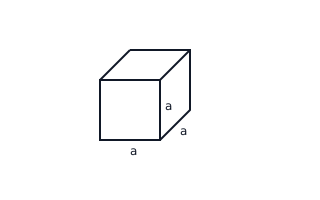
A cube is a special case of a cuboid where all edges are equal in length (). The volume is given by .
The volume of a cylinder is the product of the area of its circular base and its height (). If the radius of the base is , Volume .
Capacity is the volume of substance that a container can hold. Common units include , , and Litres ().
📐Formulae
Volume of a Cuboid:
Volume of a Cube:
Volume of a Cylinder:
Base Area of a Cylinder:
Capacity Conversion:
Capacity Conversion:
💡Examples
Problem 1:
A cuboidal water tank is long, wide, and deep. How many liters of water can it hold?
Solution:
Step 1: Identify the given dimensions: length , breadth , and height . Step 2: Use the formula for the volume of a cuboid: . Step 3: Substitute the values: . Step 4: Convert the volume from cubic meters to liters. We know that . Step 5: Total capacity in liters = .
Explanation:
To find the capacity, we first calculate the volume in cubic meters by multiplying the length, width, and depth, then convert the result to liters using the standard conversion factor.
Problem 2:
Find the height of a cylinder whose volume is and the diameter of the base is .
Solution:
Step 1: Convert all units to meters. Volume . Diameter . Radius . Step 2: Use the formula for the volume of a cylinder: . Step 3: Substitute the known values (): . Step 4: Simplify the expression: . Step 5: Further simplify: . Step 6: Solve for : .
Explanation:
The problem requires finding the height given volume and diameter. Consistency in units is key, so we converted centimeters to meters before applying the volume formula for a cylinder.
Problem 3:
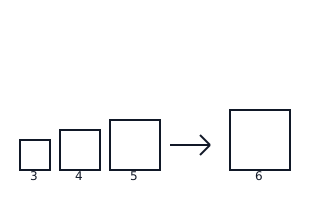
Three metallic cubes with edges , , and are melted to form a single large cube. Find the edge of the new cube.
Solution:
Volume of first cube Volume of second cube Volume of third cube Total volume of new cube Let the edge of the new cube be .
Explanation:
Since the cubes are melted and recast, the total volume remains conserved. We calculate the volumes of the three smaller cubes, sum them up to find the volume of the large cube, and then find its cube root to determine the edge length.
Problem 4:
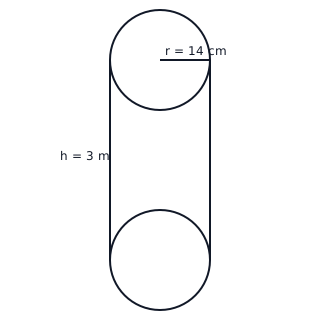
A cylindrical pillar has a radius of and a height of . Find the volume of the pillar in cubic centimeters. Also, if the cost of painting the curved surface is per , find the cost of painting such pillars (Note: Focus on volume calculation first).
Solution:
Explanation:
To find the volume of a cylinder, we use the formula . First, ensure all units are consistent by converting the height from meters to centimeters (). Substituting the values and into the formula allows us to calculate the space occupied by the pillar.