
Review the key concepts, formulae, and examples before starting your quiz.
🔑Concepts
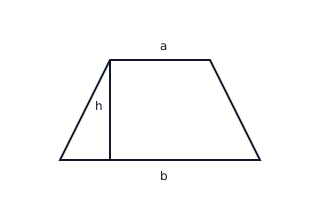
The area of a trapezium is calculated as half the sum of the lengths of parallel sides multiplied by the perpendicular distance (height) between them. Formula: Area = .
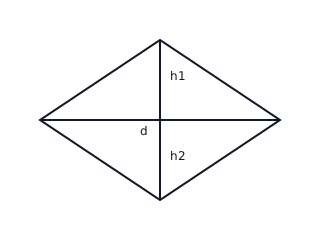
A general quadrilateral can be split into two triangles by drawing a diagonal. Its area is the sum of the areas of these two triangles: Area = , where is the diagonal and are perpendiculars from opposite vertices.
The area of a rhombus is half the product of its diagonals. Since diagonals of a rhombus bisect each other at right angles, Area = .
Area of any polygon can be found by dividing it into known shapes like triangles, rectangles, or trapeziums and summing their individual areas.
📐Formulae
Area of a Trapezium =
Area of a General Quadrilateral =
Area of a Rhombus =
Area of a Parallelogram =
Area of a Triangle =
Area of a Square =
Area of a Rectangle =
💡Examples
Problem 1:
Find the area of a trapezium whose parallel sides are and , and the perpendicular distance between them is .
Solution:
Given: Parallel side Parallel side Height
Using the formula: Area = Area = Area = Area = Area =
Explanation:
First, identify the two parallel sides (bases) and the height. Substitute these values into the trapezium area formula and perform the arithmetic operations.
Problem 2:
The area of a rhombus is . If one of its diagonals is , find the length of the other diagonal.
Solution:
Given: Area of rhombus = Diagonal
Using the formula: Area =
Explanation:
Apply the area formula for a rhombus. Since the area and one diagonal are known, rearrange the equation to solve for the unknown diagonal by dividing the area by half of the known diagonal.
Problem 3:
Calculate the area of a quadrilateral where the length of one diagonal is and the perpendiculars dropped on it from the remaining vertices are and .
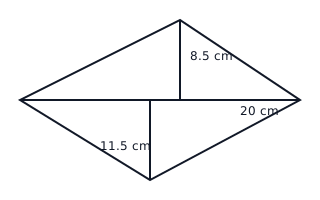
Solution:
Explanation:
To find the area of a general quadrilateral, we identify the diagonal ( ) and the two perpendicular heights ( , ) and apply the formula.
Problem 4:
The area of a trapezium is and the length of one of the parallel sides is and its height is . Find the length of the other parallel side.
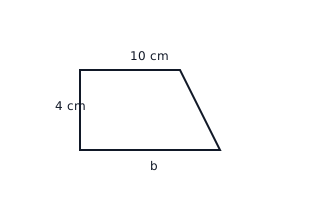
Solution:
Explanation:
Given the Area (), height (), and one parallel side (), we substitute these into the trapezium area formula and solve for the unknown side ''.