
Review the key concepts, formulae, and examples before starting your quiz.
🔑Concepts
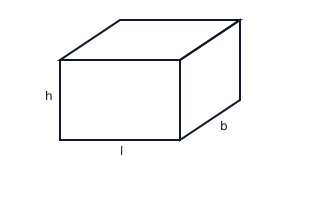
Volume refers to the amount of space occupied by a three-dimensional object. For a cuboid, it is the product of its length, breadth, and height (). Capacity is the volume of substance that a container can hold.
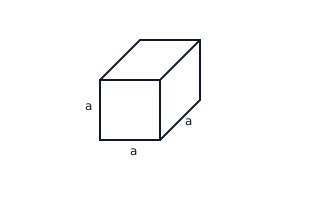
The volume of a cube is calculated by cubing the length of its side (). Since all edges are equal, it is the simplest three-dimensional regular shape for volume calculation.
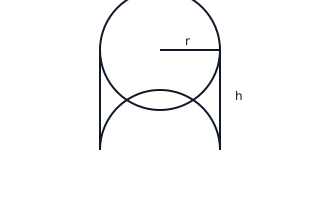
The volume of a cylinder is found by multiplying the area of its circular base () by its height (). Thus, .
Units of capacity are interlinked with units of volume. Commonly, and (which is ). is exactly equivalent to .
📐Formulae
Volume of a Cuboid =
Volume of a Cube = (where is the side length)
Volume of a Cylinder = (where is radius and is height)
Area of base of a Cuboid =
Area of base of a Cylinder =
💡Examples
Problem 1:
Find the volume of a cuboidal stone slab that is long, wide, and thick.
Solution:
Given: Length , Breadth , Height (thickness) . Using the formula for Volume of a Cuboid: . The volume of the stone slab is .
Explanation:
To find the volume, we identify the three dimensions of the cuboid and multiply them. Since all units are already in meters, the resulting volume is in cubic meters.
Problem 2:
A cylindrical tank has a base radius of and a height of . Find the capacity of the tank in liters.
Solution:
Given: Radius , Height . Step 1: Calculate Volume in : . Step 2: Convert to Liters: Since , Capacity .
Explanation:
First, ensure units are consistent by converting the radius to meters. Use the cylinder volume formula to find the space in cubic meters, then multiply by to find the capacity in liters.
Problem 3:
Find the volume of a cube whose total surface area is .
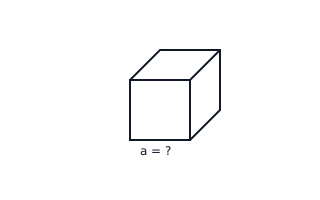
Solution:
Total Surface Area of a cube = Given, Volume of the cube =
Explanation:
First, we use the surface area formula to find the side length of the cube. Once the side length is known, we cube it to find the total volume.
Problem 4:
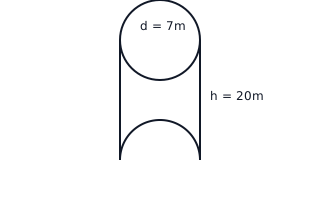
A cylindrical well is deep and has a diameter of . Find the volume of earth dug out to make the well.
Solution:
Diameter = , so Radius () = Depth () = Volume of earth = Volume of cylinder =
Explanation:
The 'earth dug out' represents the volume of the cylindrical hole. We calculate this using the radius (half of diameter) and the depth as the height.