
Review the key concepts, formulae, and examples before starting your quiz.
🔑Concepts
The Area of a Trapezium is calculated as half the product of the sum of the parallel sides and the perpendicular distance between them. In the formula , and are the parallel sides and is the height.
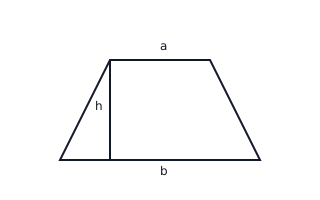
A General Quadrilateral can be divided into two triangles by drawing one of its diagonals. The area is the sum of the areas of these two triangles: , where is the diagonal and are perpendiculars (offsets) from the opposite vertices.
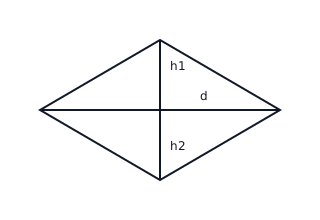
The Area of a Rhombus is half the product of its diagonals (). This is a special case of the general quadrilateral formula where the diagonals are perpendicular to each other.
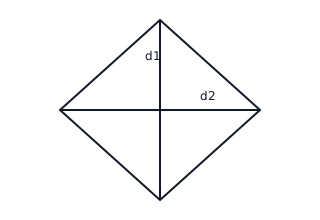
A Rhombus is also a parallelogram, so its area can be calculated as . This is useful when the side length and height (perpendicular distance between opposite sides) are known.
📐Formulae
💡Examples
Problem 1:
Find the area of a trapezium whose parallel sides are and , and the perpendicular distance between them is .
Solution:
- Identify given values: , ,
- Apply formula:
- Substitute:
- Calculate:
Explanation:
We use the standard trapezium area formula by adding the parallel sides, multiplying by the height, and dividing by 2.
Problem 2:
The diagonal of a quadrilateral is and the perpendiculars dropped on it from the opposite vertices are and . Find the area.
Solution:
- Identify given values: , ,
- Apply formula:
- Substitute:
- Calculate sum:
- Final calculation:
Explanation:
To find the area of a general quadrilateral, we treat it as two triangles sharing the same diagonal base and sum their individual areas.
Problem 3:
Find the area of a rhombus whose side is and whose altitude is . If one of its diagonals is long, find the length of the other diagonal.
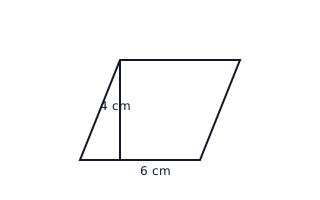
Solution:
- Area of rhombus = Area =
- Also, Area of rhombus =
Explanation:
Since a rhombus is a parallelogram, we first use the base and altitude to find the area. Then, we use the diagonal formula for the area of a rhombus to solve for the unknown diagonal.
Problem 4:
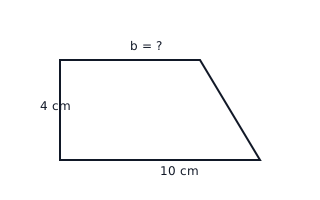
The area of a trapezium is and the length of one of the parallel sides is and its height is . Find the length of the other parallel side.
Solution:
Let the length of the other parallel side be . Area of trapezium =
Explanation:
We substitute the known values (Area, , and ) into the trapezium area formula and solve the linear equation for the unknown side .