
Review the key concepts, formulae, and examples before starting your quiz.
🔑Concepts
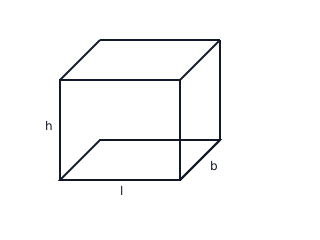
Surface Area refers to the total area of all the faces of a 3D object. For a cuboid with length , breadth , and height , the Total Surface Area (TSA) is the sum of the areas of its 6 rectangular faces: . The Lateral Surface Area (LSA) excludes the top and bottom faces, given by .
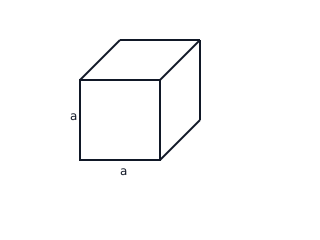
A cube is a special cuboid where all edges are of equal length . Since it has 6 identical square faces, its Total Surface Area is . The Lateral Surface Area, which covers only the 4 side faces, is .
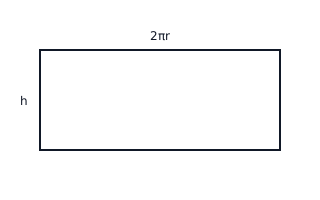
A cylinder consists of two congruent circular bases and a curved surface. The Curved Surface Area (CSA) is , which represents the area of the side when 'unrolled' into a rectangle. The Total Surface Area (TSA) includes the CSA plus the area of the two circular ends: .
When a cylindrical surface is opened along its height, it forms a rectangle where the length is the circumference of the base and the breadth is the height . This explains why .
📐Formulae
Total Surface Area of a Cuboid =
Lateral Surface Area of a Cuboid =
Total Surface Area of a Cube =
Lateral Surface Area of a Cube =
Curved Surface Area (CSA) of a Cylinder =
Total Surface Area (TSA) of a Cylinder =
Area of one circular base of a Cylinder =
💡Examples
Problem 1:
Find the total surface area of a cuboid whose length is , breadth is , and height is .
Solution:
Given: , , . Using the formula for Total Surface Area (TSA) of a cuboid: .
Explanation:
To find the total surface area, we calculate the area of all six rectangular faces by summing the products of the dimensions and doubling the result because opposite faces are equal.
Problem 2:
A cylindrical tank has a radius of and a height of . Find its total surface area. (Take )
Solution:
Given: , . Using the formula for Total Surface Area (TSA) of a cylinder: .
Explanation:
The total surface area includes the curved side of the tank plus the area of the circular top and bottom. We substitute the radius and height into the formula and simplify.
Problem 3:
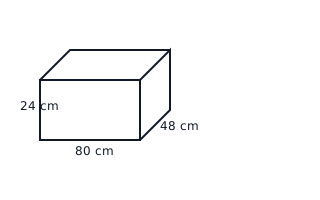
A suitcase measures . How many meters of tarpaulin of width is required to cover such suitcases?
Solution:
-
Find TSA of one suitcase:
-
TSA of suitcases:
-
Find length of tarpaulin: Area of tarpaulin = Length Width
-
Convert to meters:
Explanation:
We first calculate the total surface area of one suitcase to find the amount of fabric needed for one. Multiplying by 100 gives the total area required. Since the tarpaulin is rectangular, dividing its total area by its width gives the required length.
Problem 4:
The curved surface area of a hollow cylinder is . It is cut along its height and forms a rectangular sheet of width . Find the perimeter of the rectangular sheet.
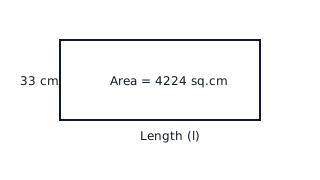
Solution:
-
Area of rectangular sheet = Curved Surface Area of cylinder
-
Find length () of the sheet:
-
Find perimeter of the sheet:
Explanation:
When a cylinder is cut vertically, the curved surface unfolds into a rectangle. The height of the cylinder becomes one side of the rectangle, and the circumference becomes the other side. Here, the width is given, so we find the length and then calculate the perimeter.