krit.club logo

Geometry and Measure - Units of measurement and conversions

Grade 7Cambridge (IGCSE)

Review the key concepts, formulae, and examples before starting your quiz.

🔑Concepts

•

The Metric System for length uses base 10. To convert from a larger unit to a smaller unit, you multiply by the conversion factor (10, 100, or 1000). To convert from a smaller unit to a larger unit, you divide by the factor.

Flowchart showing multiplication and division factors for metric length conversions.
•

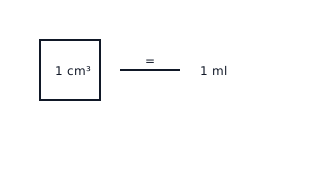
Mass and capacity follow similar powers of 1000. 1 kg=1000 g1 \text{ kg} = 1000 \text{ g} and 1 litre=1000 ml1 \text{ litre} = 1000 \text{ ml}. When working with liquid volume, remember that 1 ml1 \text{ ml} is equivalent to 1 cm31 \text{ cm}^3.

Visual representation showing that 1 cubic centimetre is equal to 1 millilitre.
•

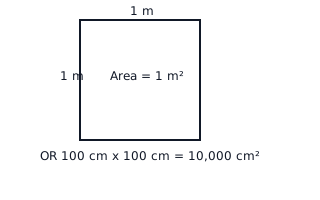
Area conversions require squaring the linear conversion factor. For example, since 1 m=100 cm1 \text{ m} = 100 \text{ cm}, then 1 m2=100×100=10,000 cm21 \text{ m}^2 = 100 \times 100 = 10,000 \text{ cm}^2.

Diagram of a square showing how area conversion factor is squared.
•

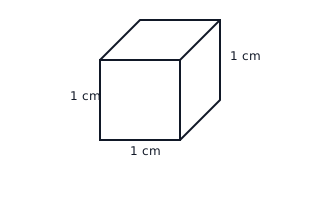
Volume conversions require cubing the linear conversion factor. For example, since 1 cm=10 mm1 \text{ cm} = 10 \text{ mm}, then 1 cm3=10×10×10=1,000 mm31 \text{ cm}^3 = 10 \times 10 \times 10 = 1,000 \text{ mm}^3.

A cube labeled 1cm on each side to show volume conversion.

📐Formulae

1 cm=10 mm1 \text{ cm} = 10 \text{ mm}

1 m=100 cm1 \text{ m} = 100 \text{ cm}

1 km=1000 m1 \text{ km} = 1000 \text{ m}

1 kg=1000 g1 \text{ kg} = 1000 \text{ g}

1 tonne=1000 kg1 \text{ tonne} = 1000 \text{ kg}

1 litre=1000 ml=1000 cm31 \text{ litre} = 1000 \text{ ml} = 1000 \text{ cm}^3

Area conversion: 1 m2=(100)2 cm2=10,000 cm2\text{Area conversion: } 1 \text{ m}^2 = (100)^2 \text{ cm}^2 = 10,000 \text{ cm}^2

Volume conversion: 1 cm3=(10)3 mm3=1,000 mm3\text{Volume conversion: } 1 \text{ cm}^3 = (10)^3 \text{ mm}^3 = 1,000 \text{ mm}^3

💡Examples

Problem 1:

Convert 4.25 kilometres into metres.

Solution:

4.25×1000=42504.25 \times 1000 = 4250 m

Explanation:

To convert from a larger unit (km) to a smaller unit (m), we multiply by the conversion factor. Since 1 km=1000 m1 \text{ km} = 1000 \text{ m}, we multiply by 1000.

Problem 2:

A bottle contains 750 ml of juice. How many litres is this?

Solution:

750÷1000=0.75750 \div 1000 = 0.75 litres

Explanation:

To convert from a smaller unit (ml) to a larger unit (l), we divide. Since 1000 ml=1 l1000 \text{ ml} = 1 \text{ l}, we divide the value by 1000.

Problem 3:

Convert 5 cm25 \text{ cm}^2 into  mm2\text{ mm}^2.

Solution:

5×102=5×100=500 mm25 \times 10^2 = 5 \times 100 = 500 \text{ mm}^2

Explanation:

Because area is two-dimensional, we must square the linear conversion factor. Since 1 cm=10 mm1 \text{ cm} = 10 \text{ mm}, then 1 cm2=10×10 mm21 \text{ cm}^2 = 10 \times 10 \text{ mm}^2.

Problem 4:

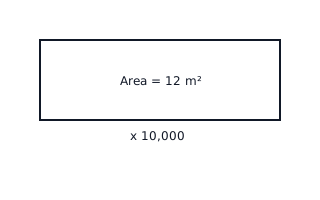
A rectangular garden bed has an area of 12 m212 \text{ m}^2. Convert this area into cm2\text{cm}^2.

A rectangle representing 12 square metres being converted.

Solution:

Step 1: Identify the linear conversion factor between metres and centimetres. 1 m=100 cm1 \text{ m} = 100 \text{ cm}

Step 2: Square the conversion factor for area. 1 m2=(100 cm)×(100 cm)=10,000 cm21 \text{ m}^2 = (100 \text{ cm}) \times (100 \text{ cm}) = 10,000 \text{ cm}^2

Step 3: Multiply the given area by the conversion factor. 12×10,000=120,000 cm212 \times 10,000 = 120,000 \text{ cm}^2

Explanation:

To convert from square metres to square centimetres, we must multiply by 100 twice (once for length and once for width).

Problem 5:

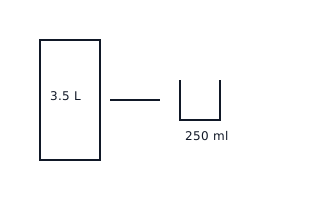
A large container holds 3.5 litres3.5 \text{ litres} of water. If you pour this into small 250 ml250 \text{ ml} cups, how many cups can you fill?

A large bottle labeled 3.5L and a small cup labeled 250ml.

Solution:

Step 1: Convert litres to millilitres. 3.5 l×1000=3,500 ml3.5 \text{ l} \times 1000 = 3,500 \text{ ml}

Step 2: Divide the total volume by the volume of one cup. 3,500÷250=143,500 \div 250 = 14

Answer: 14 cups14 \text{ cups}

Explanation:

First, we standardize the units by converting the large volume to millilitres. Then, we divide the total capacity by the capacity of a single cup.