
Review the key concepts, formulae, and examples before starting your quiz.
🔑Concepts
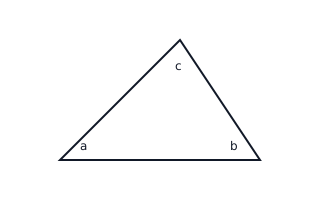
The sum of the interior angles of any triangle is always . This property allows you to find a missing angle if two are known using the formula: .
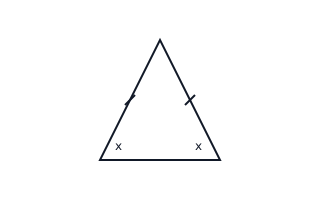
In an isosceles triangle, two sides are equal in length and the angles opposite those sides (base angles) are equal. In an equilateral triangle, all three sides are equal and each interior angle is .
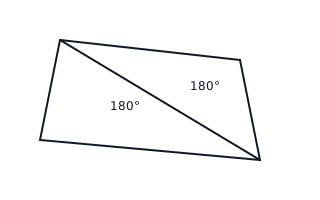
The sum of the interior angles of any quadrilateral is . This can be visualized by dividing the quadrilateral into two triangles, each contributing .
Special quadrilaterals have unique properties: Parallelograms and Rhombuses have equal opposite angles; Trapeziums have at least one pair of parallel sides where co-interior angles between them sum to .
📐Formulae
Sum of angles in a triangle:
Sum of angles in a quadrilateral:
Exterior angle of a triangle:
Sum of interior angles of a polygon with sides:
💡Examples
Problem 1:
In an isosceles triangle , the angle at the vertex is . Find the size of the two base angles and .
Solution:
Explanation:
The sum of angles in a triangle is . Subtract the vertex angle: . Since it is an isosceles triangle, the base angles are equal. Therefore, each base angle is .
Problem 2:
A quadrilateral has three angles measuring , , and . Calculate the size of the fourth angle.
Solution:
Explanation:
The sum of interior angles in a quadrilateral is . Add the known angles: . Subtract this sum from : .
Problem 3:
In triangle , the side is extended to a point . If angle and angle , find the exterior angle .
Solution:
Explanation:
According to the exterior angle property, the exterior angle of a triangle is equal to the sum of the two interior opposite angles. Thus, angle .
Problem 4:
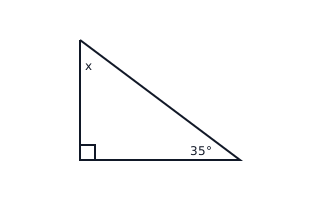
In the triangle shown, one angle is a right angle and another is . Find the value of the third angle .
Solution:
Explanation:
Since the sum of angles in a triangle is , we subtract the sum of the two known angles (the right angle and the given ) from .
Problem 5:
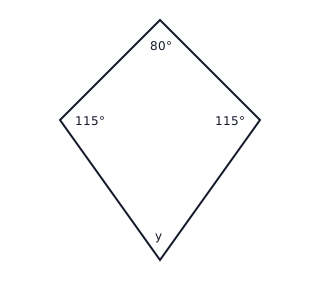
A kite has angles of at its two opposite side vertices. If the top angle is , find the size of the bottom angle .
Solution:
Explanation:
A kite has one pair of equal opposite angles. The interior sum of a quadrilateral is . By subtracting the three known angles from , we find the value of .