
Review the key concepts, formulae, and examples before starting your quiz.
🔑Concepts
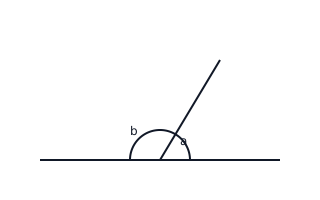
Angles on a straight line always sum to . This property allows for the calculation of an unknown angle when other angles meeting at the same point on a line are known.
When two parallel lines are cut by a transversal, alternate angles (forming a 'Z' shape) are equal, and corresponding angles (forming an 'F' shape) are equal.
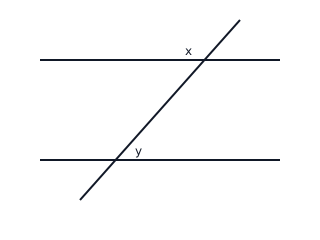
Vertically opposite angles are formed when two straight lines intersect. These angles are always equal to each other.
Regular polygons have all sides of equal length and all interior angles of equal size. The sum of interior angles depends on the number of sides .
The exterior angle of a triangle is equal to the sum of the two opposite interior angles.
📐Formulae
Sum of interior angles of an -sided polygon =
Sum of exterior angles of any convex polygon =
Individual exterior angle of a regular -sided polygon =
Individual interior angle of a regular -sided polygon =
Area of a Triangle =
Area of a Parallelogram =
💡Examples
Problem 1:
In an isosceles triangle, the vertex angle is . Find the size of the two base angles.
Solution:
each
Explanation:
The sum of angles in a triangle is . Subtract the vertex angle: . Since it is an isosceles triangle, the two base angles are equal. Therefore, .
Problem 2:
Calculate the size of one interior angle of a regular hexagon.
Solution:
Explanation:
A hexagon has sides. First, find the exterior angle: . Since the interior and exterior angles lie on a straight line, the interior angle is .
Problem 3:
Two parallel lines are intersected by a transversal. If an alternate angle is , what is the size of its corresponding co-interior angle?
Solution:
Explanation:
If the alternate angle is , the angle adjacent to it on the straight line is . This adjacent angle is equal to the co-interior partner because co-interior angles must sum to ().
Problem 4:
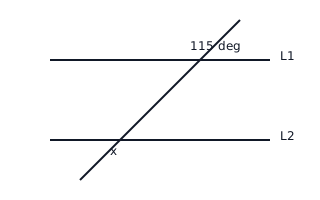
In the following diagram, lines and are parallel. Calculate the value of angle .
Solution:
- Identify that the angle and the angle adjacent to are corresponding angles if the transversal is considered.
- Alternatively, the angle and the angle co-interior to sum to .
- Let the co-interior angle be : .
- Since and are on a straight line: .
- More simply, and the angle are alternate exterior angles, or is corresponding to the vertically opposite angle of . Therefore, .
Explanation:
Using the properties of parallel lines, we can determine that is equivalent to the given angle because they are in corresponding positions.
Problem 5:
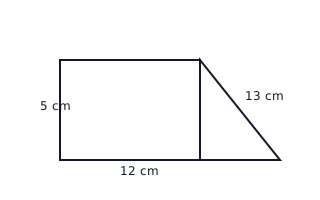
Calculate the perimeter of the composite shape shown below, which consists of a rectangle and a right-angled triangle.
Solution:
- Identify the missing side lengths. The bottom side of the rectangle is cm.
- The vertical side of the rectangle is cm, which is the same as the base of the triangle shown.
- The hypotenuse of the triangle is given as cm.
- Total Perimeter = sum of all outer boundaries.
- cm.
Explanation:
To find the perimeter, we sum only the lengths of the external boundaries of the composite shape.