
Review the key concepts, formulae, and examples before starting your quiz.
🔑Concepts
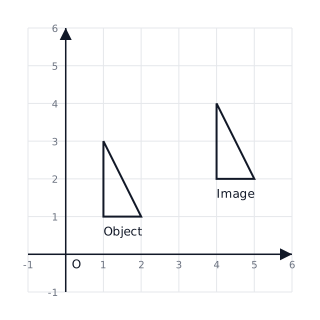
Translation involves shifting a shape in a specific direction without changing its size, orientation, or shape. This is defined by a vector , where represents horizontal displacement and represents vertical displacement.
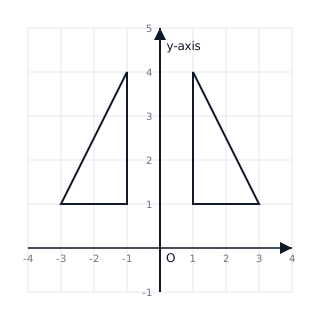
Reflection creates a mirror image of a shape across a line of reflection. Every point on the image is the same distance from the line as the corresponding point on the original object.
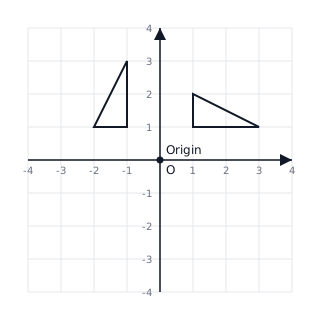
Rotation turns a shape around a fixed point called the center of rotation. You must specify the center (e.g., ), the angle (e.g., ), and the direction (clockwise or anti-clockwise).
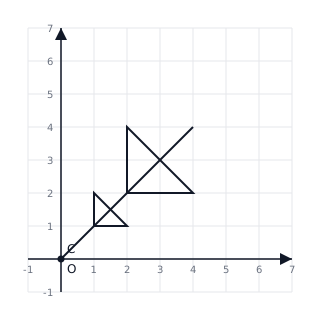
Enlargement changes the size of a shape by a scale factor from a center of enlargement. If , the shape gets larger; if , the shape gets smaller.
📐Formulae
Translation Vector: (where is horizontal movement and is vertical movement)
Scale Factor ():
Reflection in -axis:
Reflection in -axis:
Rotation about origin:
💡Examples
Problem 1:
A triangle with vertices , , and is translated by the vector . Find the new coordinates of .
Solution:
Explanation:
To translate a point, add the component of the vector to the -coordinate and the component of the vector to the -coordinate.
Problem 2:
Reflect the point in the line .
Solution:
Explanation:
When reflecting in the line , the and coordinates are swapped.
Problem 3:
A square has a side length of cm. It is enlarged by a scale factor of . What is the side length of the new square?
Solution:
Explanation:
To find the new length after enlargement, multiply the original length by the scale factor .
Problem 4:
Rotate the point anti-clockwise about the origin .
Solution:
Explanation:
A anti-clockwise rotation moves a point from the positive -axis to the positive -axis.
Problem 5:
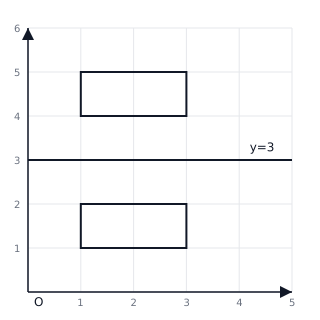
A rectangle has vertices at , , , and . It is reflected in the line . Find the coordinates of the reflected image .
Solution:
- Identify the distance of each point from the line .
- Point is units below the line, so will be units above the line at .
- Point is units below the line, so will be .
- Point is unit below the line, so will be .
- Point is unit below the line, so will be . Final coordinates: .
Explanation:
Reflecting across a horizontal line keeps the -coordinate the same while the -coordinate changes such that the line is the midpoint.
Problem 6:
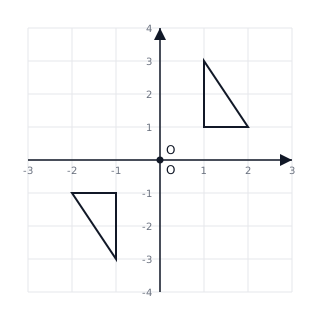
Rotate the triangle with vertices , , and by about the point .
Solution:
For a rotation of about the origin, the rule applies.
Explanation:
A rotation is equivalent to reflecting in both the and axes sequentially, effectively negating both coordinates.