
Review the key concepts, formulae, and examples before starting your quiz.
🔑Concepts
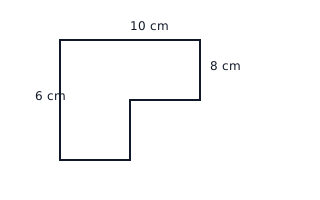
Perimeter is the total distance around the outside of a 2D shape. For composite shapes, sum all external side lengths.
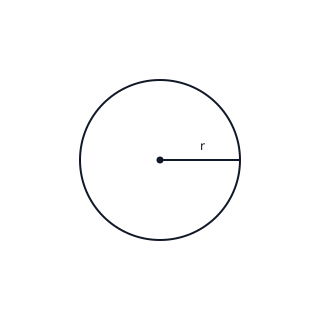
The Area of a circle is calculated using the radius with the formula . The radius is half of the diameter .
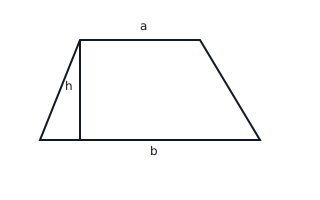
A Trapezium has one pair of parallel sides ( and ). The area is the average of these sides multiplied by the perpendicular height : .
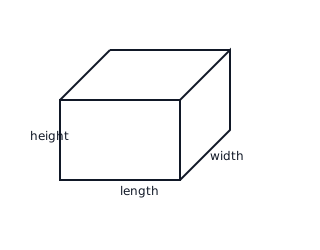
Volume of a prism (like a cuboid) is the area of the cross-section multiplied by its length. For a cuboid, .
📐Formulae
💡Examples
Problem 1:
A triangle has a base of 14 cm and a perpendicular height of 9 cm. Calculate its area.
Solution:
Explanation:
Apply the area of a triangle formula: . Calculation: .
Problem 2:
Find the circumference of a circle with a diameter of 10 cm. (Use )
Solution:
Explanation:
Using the formula , multiply the diameter by : .
Problem 3:
A cereal box (cuboid) has dimensions 20 cm by 5 cm by 30 cm. Find its volume.
Solution:
Explanation:
Volume of a cuboid is found by multiplying length, width, and height: .
Problem 4:
Calculate the area of a trapezium where the parallel sides are 8 cm and 12 cm, and the height is 5 cm.
Solution:
Explanation:
Use the formula . First, add the parallel sides (). Then, .
Problem 5:
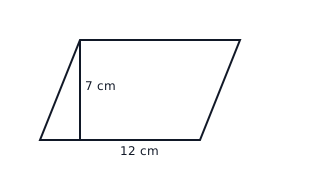
Calculate the area of a parallelogram with a base of and a perpendicular height of .
Solution:
Explanation:
To find the area of a parallelogram, multiply the length of the base by the perpendicular height. Do not use the slanted side length.
Problem 6:
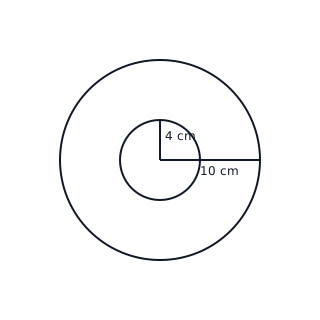
Find the area of the shaded region: a large circle with radius has a smaller circle with radius removed from its center.
Solution:
Explanation:
To find the area of a ring (annulus), calculate the area of the outer circle and subtract the area of the inner circle.