
Review the key concepts, formulae, and examples before starting your quiz.
🔑Concepts
The SSS (Side-Side-Side) criterion states that a triangle can be uniquely constructed if the lengths of all three of its sides are known.
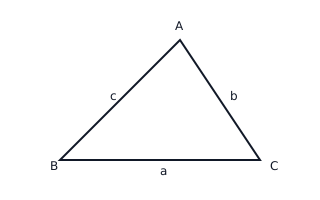
Before starting construction, always verify the Triangle Inequality Theorem: the sum of the lengths of any two sides must be strictly greater than the length of the third side. If , no triangle can be formed.
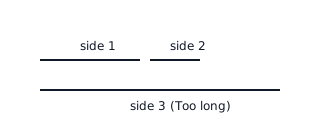
Construction Step 1: Draw the longest side as a base using a ruler. Label the endpoints (e.g., and for side ).
Construction Step 2: Use a compass. Set the width to the second side length, place the pointer on one endpoint, and draw an arc above the base line.
Construction Step 3: Adjust the compass to the third side length. Place the pointer on the other endpoint and draw a second arc intersecting the first one. The intersection point is the third vertex.
📐Formulae
Condition for existence:
Triangle Inequality 1:
Triangle Inequality 2:
Triangle Inequality 3:
Perimeter of the triangle:
💡Examples
Problem 1:
Construct a triangle such that , , and .
Solution:
Step 1: Check the inequality: , , and . Since all are true, construction is possible. \nStep 2: Draw a line segment using a ruler. \nStep 3: With as the center and a radius of (length of ), draw an arc using a compass. \nStep 4: With as the center and a radius of (length of ), draw another arc cutting the previous arc at point . \nStep 5: Join and using a ruler.
Explanation:
This follows the SSS construction method. We start with the base and use the compass to find the exact point that is simultaneously away from and away from .
Problem 2:
Determine if a triangle can be constructed with sides , , and .
Solution:
Step 1: Identify the lengths: , , . \nStep 2: Apply the Triangle Inequality Property: . \nStep 3: Compare the sum to the third side: . \nStep 4: Since the sum of the two shorter sides is not greater than the third side, the condition is not satisfied.
Explanation:
In SSS construction, if the sum of two sides is less than or equal to the third side, the arcs drawn from the endpoints of the base will never meet. Therefore, a triangle cannot be formed.
Problem 3:
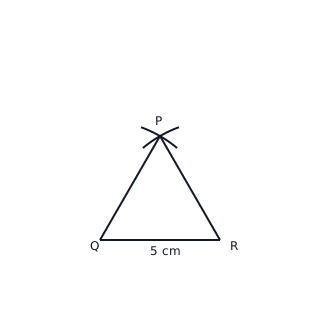
Construct an equilateral triangle with each side measuring .
Solution:
- Draw a line segment .
- Taking as center and radius , draw an arc.
- Taking as center and radius , draw another arc to intersect the previous arc at .
- Join and .
Explanation:
In an equilateral triangle, all three sides are equal. Since , we use the SSS construction method with equal radii for both arcs.
Problem 4:
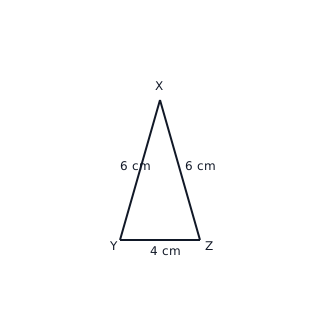
Construct an isosceles triangle where and .
Solution:
- Draw the base .
- With as center and radius , draw an arc.
- With as center and radius , draw an arc intersecting the first arc at .
- Join and .
Explanation:
Since two sides are equal ( each), the arcs drawn from and will have the same radius, making the triangle symmetric about the perpendicular bisector of the base.