
Review the key concepts, formulae, and examples before starting your quiz.
🔑Concepts
The fundamental concept of constructing parallel lines relies on the properties of a transversal intersecting two lines. If a transversal intersects two lines such that a pair of alternate interior angles are equal, then the lines must be parallel.
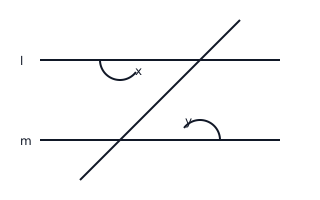
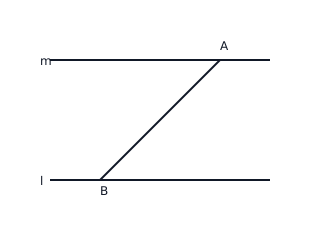
The step-by-step construction involves: 1. Taking a line and a point outside it. 2. Taking any point on and joining . 3. Constructing an angle at equal to on the opposite side of the transversal to create alternate interior angles.
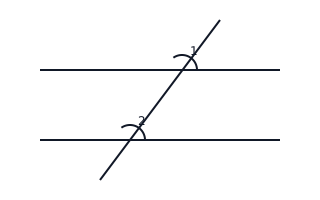
Corresponding angles property can also be used for construction. If a transversal intersects two lines such that a pair of corresponding angles are equal, the lines are parallel.
The distance between two parallel lines remains constant throughout their length. This 'perpendicular distance' can be used to construct a parallel line at a specific offset from the original line.
📐Formulae
If (Alternate Interior Angles), then
If (Corresponding Angles), then
Sum of interior angles on the same side of transversal: (Co-interior angles)
Distance between lines and is constant: for any points on
💡Examples
Problem 1:
Draw a line . Take a point outside it. Through , draw a line parallel to using the concept of alternate interior angles.
Solution:
- Draw a line and mark a point outside the line.
- Mark any point on the line and join the points and . Now, is the transversal.
- With as the center and any convenient radius, draw an arc cutting at point and at point .
- With as the center and the same radius as in step 3, draw an arc cutting at point .
- Place the compass pointer at and adjust the opening to measure the distance to .
- With the same opening and as the center, draw an arc to cut the arc at point .
- Draw a line passing through points and .
Explanation:
This construction replicates the angle at point such that . Since these are alternate interior angles and are made equal, line becomes parallel to line .
Problem 2:
Given a line and a point at a distance of cm from it, construct a line parallel to passing through .
Solution:
- Draw a line .
- Take any point on line and draw a perpendicular line using a protractor or compass at .
- With as the center and a radius of cm on the compass, draw an arc cutting the perpendicular line at point .
- At point , draw another perpendicular line to the segment .
- Extend this line on both sides to name it line .
Explanation:
Since line is perpendicular to and line is also perpendicular to , line and line are parallel because they are both perpendicular to the same transversal line at a distance of cm.
Problem 3:
Draw a line . Mark a point outside it. Using a ruler and compass, construct a line passing through such that .
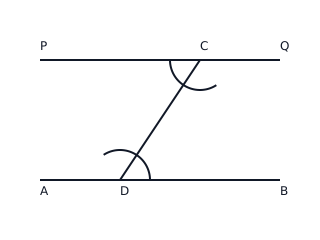
Solution:
- Draw line and mark point outside.
- Take any point on and join .
- With as center and a convenient radius, draw an arc cutting at and at .
- With as center and the same radius, draw an arc cutting at .
- Adjust the compass to the width of arc . With as center and this width, cut arc at point .
- Join and extend it to form line . Line is parallel to .
Explanation:
This construction uses the principle of Alternate Interior Angles. By making , we ensure the lines are parallel.
Problem 4:
Draw a line . Construct a line parallel to at a distance of cm from it.
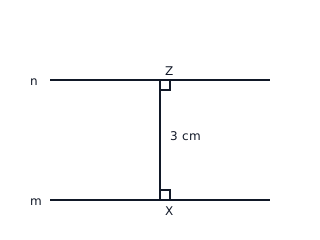
Solution:
- Draw a line .
- Take any point on and construct a perpendicular of any length.
- Using a compass, mark a point on such that cm.
- At point , construct another perpendicular to the line .
- Line is parallel to line and is at a distance of cm.
Explanation:
Since both lines and are perpendicular to the same line , they are parallel to each other. The distance cm defines the separation.