
Review the key concepts, formulae, and examples before starting your quiz.
🔑Concepts
The ASA (Angle-Side-Angle) criterion states that a unique triangle can be constructed if two angles and the length of the side included between them are given.
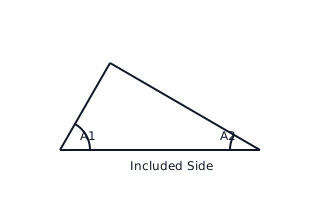
Before starting the construction, always check if the sum of the two given angles is less than . If , a triangle cannot be formed.
If two angles are given but the side provided is not the included side, use the Angle Sum Property () to find the angle adjacent to the given side.
Steps of Construction: 1. Draw the given side as a base line segment. 2. Use a protractor or compass to draw the two given angles at the endpoints of the segment. 3. Extend the rays until they intersect at the third vertex.
📐Formulae
💡Examples
Problem 1:
Construct given , and .
Solution:
Step 1: Draw a line segment of length using a ruler. Step 2: At point , use a protractor to draw a ray making an angle of with . Step 3: At point , use a protractor to draw a ray making an angle of with . Step 4: The point where rays and intersect is the vertex . Step 5: Label the triangle with the given dimensions.
Explanation:
Since is the side included between and , we can directly use the ASA criterion. We verify that , which is less than , so the construction is possible.
Problem 2:
Construct where , , and .
Solution:
Step 1: Calculate using the Angle Sum Property: . Step 2: Draw the base using a ruler. Step 3: At , draw a ray making with . Step 4: At , draw a ray making with . Step 5: Mark the intersection of these two rays as .
Explanation:
In this problem, the given side is not included between and . To use the ASA criterion, we must find (the angle adjacent to side along with ) before drawing.
Problem 3:
Construct where , , and .
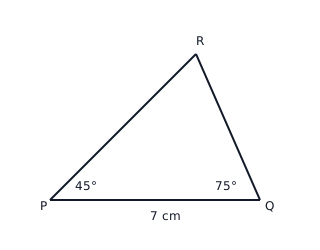
Solution:
- Draw a line segment .
- At point , draw a ray making an angle of with .
- At point , draw a ray making an angle of with .
- Mark the point where the two rays intersect as . is the required triangle.
Explanation:
This is a direct application of the ASA criterion because the side lies between the given angles and .
Problem 4:
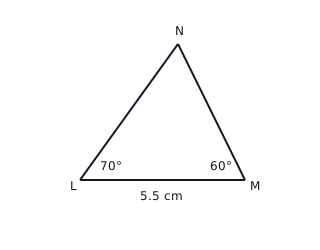
Construct given , , and .
Solution:
- First, find using the Angle Sum Property: .
- Draw .
- Construct and at the respective endpoints.
- Their intersection point is .
Explanation:
Since the given side is not the included side for angles and , we must first calculate so that we have two angles adjacent to the known side .