
Review the key concepts, formulae, and examples before starting your quiz.
🔑Concepts
The RHS criterion stands for Right angle-Hypotenuse-Side. To construct such a triangle, we need the length of one leg (base or height), the length of the hypotenuse, and the measure of the right angle ().
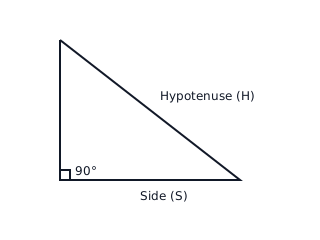
In a right-angled triangle, the side opposite the angle is the longest side, called the hypotenuse. According to the Pythagoras theorem, the square of the hypotenuse equals the sum of the squares of the other two sides: .
The construction process begins by drawing the base leg. Then, a perpendicular line () is constructed at one endpoint using a protractor or compass. Finally, an arc of the hypotenuse's length is drawn from the other endpoint of the base to intersect the perpendicular line.
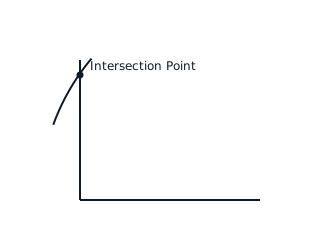
The point of intersection between the hypotenuse arc and the perpendicular line defines the third vertex of the triangle.
📐Formulae
Pythagoras Theorem: (where is the hypotenuse)
Angle Sum Property:
In any right-angled triangle:
💡Examples
Problem 1:
Construct a right-angled triangle , right-angled at , where and hypotenuse .
Solution:
- Draw a horizontal line segment using a ruler.
- At point , use a protractor or compass to draw a ray such that . This ray should be perpendicular to .
- Set the compass to a radius of . Place the compass pointer at point .
- Draw an arc that cuts the ray at a point. Label this point .
- Join to using a ruler. is the required right-angled triangle.
Explanation:
Since the triangle is right-angled at , is treated as the base and is the perpendicular height. The hypotenuse must connect the far end of the base () to the height (). The compass ensures the length is exactly .
Problem 2:
Construct such that , , and .
Solution:
- Draw the base .
- At vertex , construct a angle and draw a ray upwards.
- With as the center and a radius of , draw an arc intersecting ray at point .
- Join . The triangle is constructed.
Explanation:
In this RHS problem, the side is one leg and is the hypotenuse (the side opposite the angle at ). We use the compass from to find the point on the vertical line .
Problem 3:
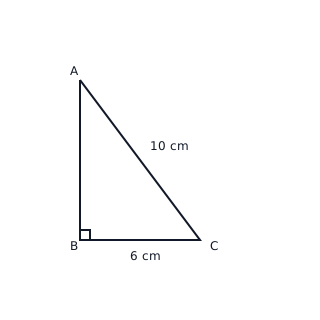
Construct a right-angled triangle , right-angled at , given that and .
Solution:
- Draw a line segment .
- At point , construct a ray making an angle of with .
- With as center and radius (the hypotenuse), draw an arc intersecting ray at point .
- Join to complete the triangle .
Explanation:
Since the triangle is right-angled at , must be the hypotenuse. We use the RHS criterion where , , and .
Problem 4:
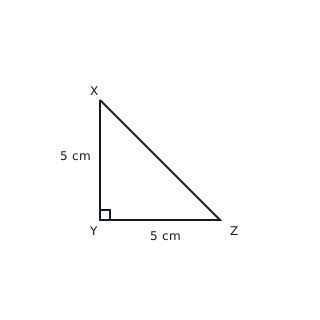
Construct an isosceles right-angled triangle where and the equal sides are each.
Solution:
- Draw a line segment .
- At point , construct a ray perpendicular to ().
- From , mark a point on ray such that .
- Join .
Explanation:
In an isosceles right triangle, the two legs forming the right angle are equal. Here . The hypotenuse is determined by connecting the endpoints of these legs.