
Review the key concepts, formulae, and examples before starting your quiz.
🔑Concepts
The SAS (Side-Angle-Side) criterion states that a unique triangle can be constructed when the lengths of two sides and the measure of the angle included between them are known.
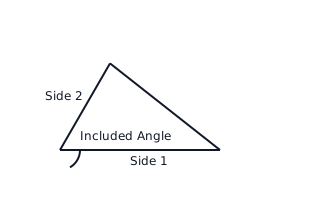
To construct an SAS triangle, start by drawing the longest known side as the base, then use a protractor or compass to mark the included angle at one endpoint.
The order of components is vital; the angle must be 'sandwiched' between the two given sides. If the angle is not between the sides (SSA), a unique triangle may not be formed.
Before starting construction, always draw a rough sketch to visualize the positions of the vertices and the given dimensions.
📐Formulae
SAS Congruence Criterion: if , , and
Sum of Interior Angles:
Triangle Inequality (Requirement for existence):
💡Examples
Problem 1:
Construct a triangle given , , and .
Solution:
Step 1: Draw a rough sketch of and label the given parts. Step 2: Draw a line segment of length using a ruler. Step 3: At point , draw a ray making an angle of with using a protractor. Step 4: With as center and a radius of (the length of ), draw an arc using a compass to cut the ray at point . Step 5: Join using a ruler to complete the triangle.
Explanation:
We start with the longest side as the base. Since is given, we must construct the angle at vertex . The arc of ensures that the side is exactly the required length before we close the triangle by joining to .
Problem 2:
Construct an isosceles triangle where the two equal sides and are each and the angle between them is .
Solution:
Step 1: Draw a line segment . Step 2: At point , use a protractor to draw a ray such that . Step 3: Use a compass set to width. With as center, draw an arc cutting ray at point . Step 4: Join . Step 5: is the required isosceles triangle with and .
Explanation:
In an isosceles triangle with a given included angle, we treat the two equal sides as the two sides of the SAS criterion. Since is the angle between and , it must be constructed at the shared vertex .
Problem 3:
Construct where , , and .
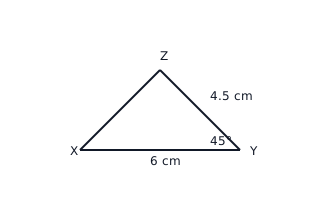
Solution:
- Draw a line segment .
- At point , use a protractor to draw a ray making an angle of with .
- Using as center and a radius of , draw an arc to intersect ray at point .
- Join and to complete the triangle .
Explanation:
This follows the SAS criterion because the known angle is located between the two known sides and .
Problem 4:
Construct an isosceles triangle where and .
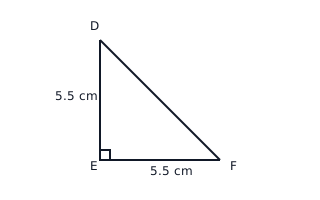
Solution:
- Draw base .
- At point , construct a perpendicular ray ().
- From , mark a point on the ray such that .
- Join and .
Explanation:
Since , this is an isosceles right-angled triangle. The SAS criterion is satisfied using the two equal sides and the angle between them.