
Review the key concepts, formulae, and examples before starting your quiz.
🔑Concepts
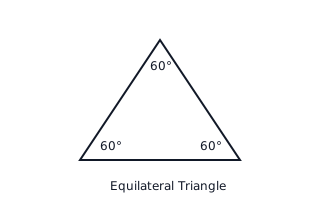
Classification by Sides: Triangles can be Scalene (no equal sides), Isosceles (two equal sides), or Equilateral (all three sides equal). In an equilateral triangle, all internal angles are exactly .
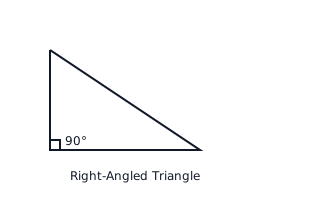
Classification by Angles: Triangles are Acute-angled (all angles ), Right-angled (one angle ), or Obtuse-angled (one angle ).
Angle Sum Property: The sum of the interior angles of any triangle is always . This allows us to find a missing angle if two are known using .
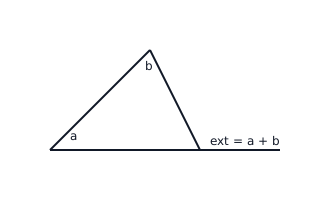
Exterior Angle Property: An exterior angle of a triangle is equal to the sum of its two interior opposite angles.
📐Formulae
💡Examples
Problem 1:
In a triangle, two angles are and . Find the third angle and classify the triangle by its angles.
Solution:
Let the third angle be . By the Angle Sum Property: First, calculate the sum of the known angles: So, . Now, subtract from : The third angle is . Since all angles (, , ) are less than , it is an acute-angled triangle.
Explanation:
We apply the Angle Sum Property which states that the sum of angles in a triangle is . After finding the missing angle, we check if any angle exceeds to classify it.
Problem 2:
An isosceles triangle has one vertex angle of . Find the measure of the other two equal angles.
Solution:
Let each of the equal angles be . Using the Angle Sum Property: . Each equal angle is .
Explanation:
In an isosceles triangle, the angles opposite the equal sides must be equal. We set up an equation where plus the known vertex angle equals .
Problem 3:
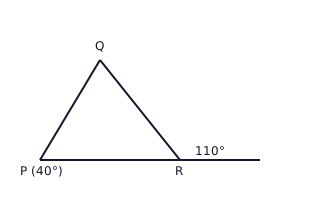
In the given triangle , and the exterior angle at is . Find the measure of .
Solution:
- According to the Exterior Angle Property:
- Substitute the known values:
- Solve for :
Explanation:
The exterior angle is equal to the sum of the interior opposite angles. By subtracting the given interior angle from the exterior angle, we find the other interior opposite angle.
Problem 4:
In a right-angled triangle, one of the acute angles is . Calculate the third angle.
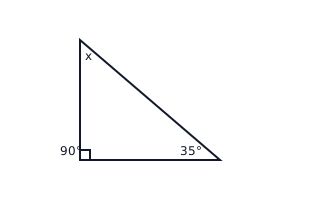
Solution:
- In a right-angled triangle, one angle is always .
- Let the angles be , , and .
- Using the Angle Sum Property:
- Solve for :
Explanation:
Since the sum of angles in a triangle is and one angle is , the two acute angles must sum to . We subtract the given acute angle from to find the third angle.