
Review the key concepts, formulae, and examples before starting your quiz.
🔑Concepts
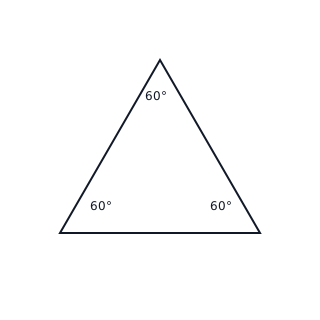
An equilateral triangle is formed when three lines intersect such that the internal angles are all equal to . By the Angle Sum Property, since the total is , each angle must be .
In an equilateral triangle, all three sides are of equal length (). If any one side is known, the other two sides and the total perimeter can be determined immediately.
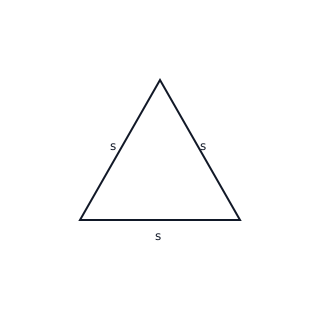
The perimeter of an equilateral triangle is the total boundary length, calculated as . Conversely, the side length is .
Three intersecting lines can form different types of triangles; however, if the lines are positioned such that the exterior angle is at every vertex, the interior triangle is guaranteed to be equilateral.
📐Formulae
💡Examples
Problem 1:
In an equilateral triangle , if the length of side is , find the perimeter of the triangle.
Solution:
Explanation:
Since all sides of an equilateral triangle are equal, . The perimeter is the sum of all sides: .
Problem 2:
Find the value of if the angles of a triangle formed by three intersecting lines are , , and , and it is given that the triangle is equilateral.
Solution:
Explanation:
In an equilateral triangle, all interior angles must be equal to . Therefore, if one angle is and the triangle is equilateral, the other two angles must also be .
Problem 3:
The perimeter of an equilateral triangle is . Calculate the length of each side.
Solution:
Explanation:
To find the side of an equilateral triangle when the perimeter is known, we use the formula . Substituting the values: .
Problem 4:
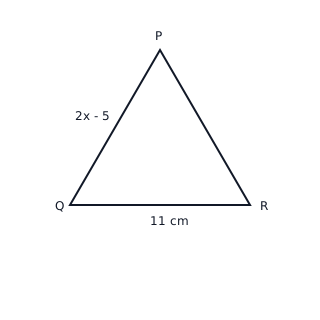
Given an equilateral triangle where one side is and another side is , find the value of .
Solution:
In an equilateral triangle, all sides are equal. Add to both sides: Divide by :
Explanation:
Since the triangle is defined as equilateral, we set the expression for side equal to the known length of side and solve for the unknown variable .
Problem 5:
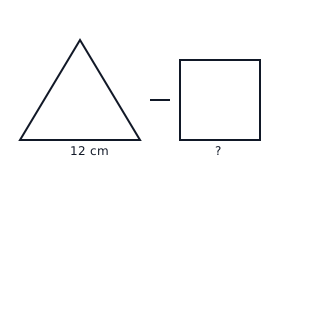
A wire is bent into the shape of an equilateral triangle with a side length of . If the same wire is straightened and then bent into a square, what would be the length of each side of the square?
Solution:
Step 1: Find the total length of the wire (Perimeter of the triangle). Step 2: The perimeter of the square will be the same as the wire length. Step 3: Solve for the side of the square.
Explanation:
The length of the wire remains constant. First, we find the perimeter of the equilateral triangle, then divide that total length by 4 to find the side of a square.