
A Tale of Three Intersecting Lines - Construction of Triangles When Some Sides and Angles are Known
Review the key concepts, formulae, and examples before starting your quiz.
🔑Concepts
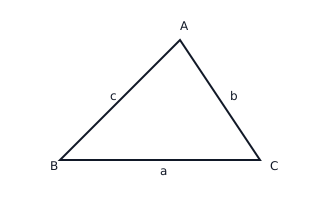
The SSS (Side-Side-Side) Criterion: A triangle can be constructed if the lengths of all three sides are known, provided the sum of any two sides is greater than the third side ().
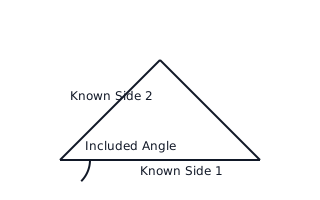
The SAS (Side-Angle-Side) Criterion: Construction is possible when two sides and the angle included between them are given. The angle must be formed by the two known sides.
The ASA (Angle-Side-Angle) Criterion: Construction requires one side and the two angles at its endpoints. If two angles are given but not the included side, use the Angle Sum Property () to find the third angle.
The RHS (Right-angle Hypotenuse Side) Criterion: Specifically for right-angled triangles, you need the length of the hypotenuse and one other side. The angle between the base and perpendicular is always .
📐Formulae
💡Examples
Problem 1:
Construct a triangle where , , and .
Solution:
- Draw a line segment . 2. With as center and radius , draw an arc. 3. With as center and radius , draw another arc intersecting the previous arc at point . 4. Join and .
Explanation:
This follows the SSS (Side-Side-Side) criterion. Since , the triangle construction is possible.
Problem 2:
Construct given , , and .
Solution:
- Draw a line segment . 2. At point , use a protractor or compass to draw an angle of . 3. From , cut an arc of length on the angle ray to mark point . 4. Join .
Explanation:
This is an SAS construction because we are given two sides and the angle included between them.
Problem 3:
In , and . If the side , find the third angle and describe the construction.
Solution:
First, find :
- Draw . 2. At , draw a ray at . 3. At , draw a ray at . 4. The intersection point is .
Explanation:
This uses the ASA criterion. We must ensure the sum of the two given angles is less than for the triangle to exist.
Problem 4:
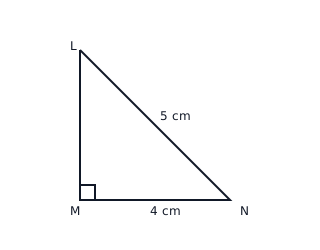
Construct a right-angled triangle , where , , and hypotenuse .
Solution:
- Draw a line segment .
- At point , draw a ray perpendicular to (making an angle of ).
- With as the center and a radius of (the hypotenuse), draw an arc that intersects the ray at point .
- Join to complete the triangle .
Explanation:
This construction uses the RHS (Right-angle Hypotenuse Side) property. By drawing the angle first, we establish the direction of the perpendicular side, and the hypotenuse arc fixes the height of the triangle.
Problem 5:
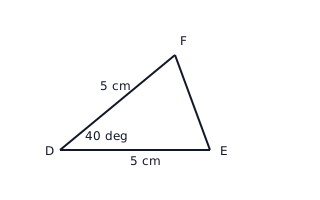
Construct an isosceles triangle where the equal sides and are each and the angle between them is .
Solution:
- Draw a ray .
- Mark a point on such that .
- At point , use a protractor to draw an angle of with respect to . Label this ray .
- On ray , mark a point such that .
- Join to form the triangle .
Explanation:
Since two sides and the included angle are given, we use the SAS criterion. Because , the triangle is isosceles.