
Review the key concepts, formulae, and examples before starting your quiz.
🔑Concepts
A triangle can only be constructed if the sum of the lengths of any two sides is strictly greater than the length of the third side. This is known as the Triangle Inequality Property: , , and .
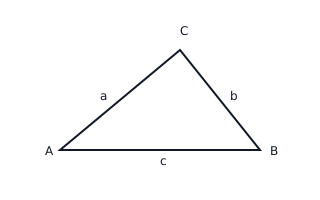
The SSS (Side-Side-Side) Criterion: If the lengths of all three sides of a triangle are given and they satisfy the triangle inequality, a unique triangle can be constructed using a ruler and a compass.
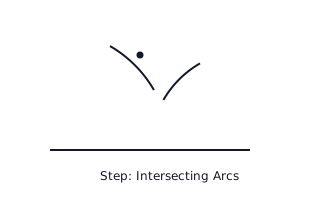
To construct a triangle using SSS: 1. Draw the longest side as the base. 2. From one end, draw an arc with a radius equal to the second side. 3. From the other end, draw an arc with a radius equal to the third side. 4. Connect the point of intersection of the arcs to the endpoints of the base.
If the sum of two shorter sides is equal to the third side (), the 'arcs' will meet exactly on the base line, resulting in a straight line rather than a triangle. If , the arcs will never meet.
📐Formulae
💡Examples
Problem 1:
Construct a triangle with side lengths , , and . Verify if the construction is possible.
Solution:
First, check the Triangle Inequality:
- , and
- , and
- , and Since all conditions are met, construction is possible. Steps:
- Draw a line segment using a ruler.
- With as center and radius , draw an arc using a compass.
- With as center and radius , draw another arc intersecting the previous arc at point .
- Join and . is the required triangle.
Explanation:
We use the SSS criterion. By checking the sum of the sides, we ensure the arcs will actually intersect to form a vertex.
Problem 2:
Can you construct a triangle with sides , , and ?
Solution:
Check the sum of the two smaller sides: Here, . We compare this to the third side: . Since the sum of two sides () is not greater than the third side (), the triangle cannot be formed.
Explanation:
According to the triangle inequality property, must be greater than . Because is less than , the arcs drawn from the endpoints of the base would never meet.
Problem 3:
Construct a triangle where , , and . What kind of triangle is this?
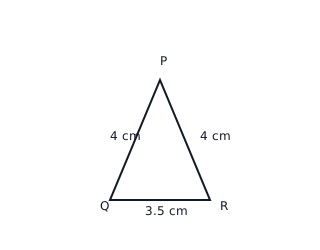
Solution:
- Check the property: ; . Construction is possible.
- Draw as the base.
- Using a compass, draw an arc of radius from point .
- Draw another arc of radius from point .
- Mark the intersection as and join and . Since , the triangle is an Isosceles Triangle.
Explanation:
Because two sides are of equal length, the triangle formed is isosceles. The intersection of equal arcs from the base endpoints ensures the top vertex is equidistant from both.
Problem 4:
Construct an equilateral triangle with each side measuring .
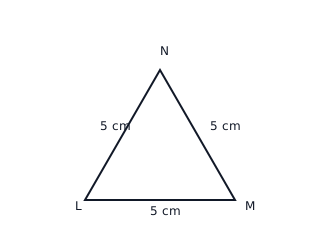
Solution:
- Draw base .
- Open the compass to .
- Draw an arc from and another arc from .
- Mark the intersection as .
- Join and . All angles will be .
Explanation:
In an equilateral triangle, all three sides are equal. The construction involves setting the compass once and using that same radius for the base and both arcs.