
Review the key concepts, formulae, and examples before starting your quiz.
🔑Concepts
An altitude of a triangle is a perpendicular line segment drawn from a vertex to the opposite side (or the line containing the opposite side). Every triangle has exactly three altitudes.
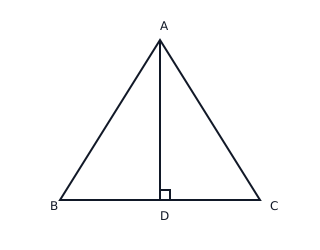
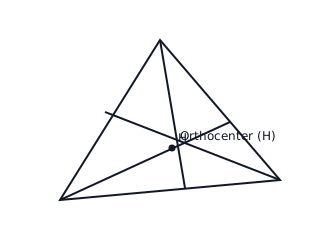
The three altitudes of a triangle always intersect at a single point called the orthocenter. In an acute-angled triangle, the orthocenter lies inside the triangle.
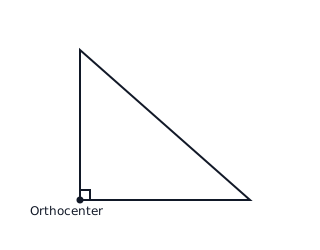
In a right-angled triangle, two of the altitudes are the sides forming the right angle. The orthocenter is exactly at the vertex containing the right angle.
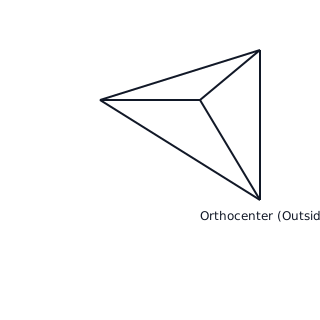
In an obtuse-angled triangle, two of the altitudes lie outside the triangle. The orthocenter is located outside the triangle.
📐Formulae
💡Examples
Problem 1:
In , the base and the corresponding altitude . Find the area of the triangle. If another altitude is drawn to side which measures , find the length of .
Solution:
- Calculate Area using : 2. Use the Area to find altitude where base is :
Explanation:
The area of a triangle remains constant regardless of which side is chosen as the base. We first find the area using the known base and altitude, then use that area to solve for the unknown altitude.
Problem 2:
Determine the position of the orthocenter for where .
Solution:
In a right-angled triangle, the altitudes from the two acute vertices are the legs of the triangle itself.
- Altitude from to is .
- Altitude from to is .
- Altitude from to is a perpendicular segment . All three meet at vertex .
Explanation:
For any right-angled triangle, the vertex where the right angle is formed serves as the orthocenter.
Problem 3:
A student calculated the areas of two triangular parts of a metal sheet. The first area is and the second is . What is the total area?
Solution:
The total area is .
Explanation:
Basic addition of areas calculated from base and altitude measurements.
Problem 4:
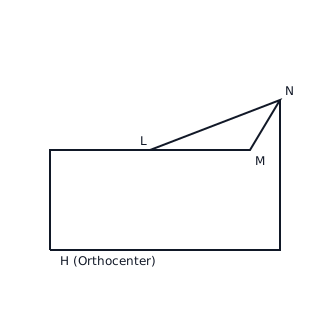
In , . If we draw altitudes from vertices and to the opposite sides, where will they meet? Illustrate with a diagram.
Solution:
- Since , the triangle is obtuse-angled.
- In an obtuse triangle, altitudes from the acute angles ( and ) fall on the extensions of the opposite sides ( and ).
- These altitudes, when extended, meet at the orthocenter located outside the triangle.
- Therefore, they meet at a point in the exterior region of the triangle.
Explanation:
For obtuse triangles, the altitudes from the two acute vertices must be drawn to the exterior lines containing the bases. Their point of intersection (orthocenter) always lies outside the triangle.
Problem 5:
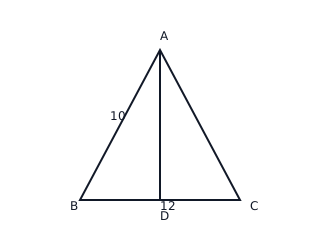
Consider an isosceles where and . Find the length of the altitude from to and then find the area of the triangle.
Solution:
- In an isosceles triangle, the altitude to the base bisects the base. So, .
- In right-angled , by Pythagoras theorem: .
- Area of .
Explanation:
The altitude in an isosceles triangle acts as a median for the non-equal side, allowing us to use the Pythagoras theorem to find its height and subsequently the area.