
Review the key concepts, formulae, and examples before starting your quiz.
🔑Concepts
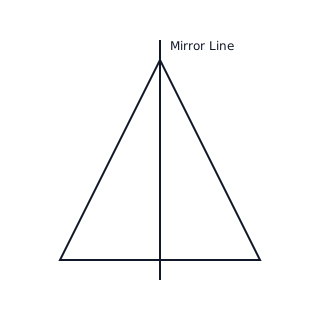
Line Symmetry (Reflectional Symmetry): A shape has a line of symmetry if it can be folded along a line so that the two halves match exactly. For example, an isosceles triangle has one line of symmetry passing through the vertex between the equal sides.
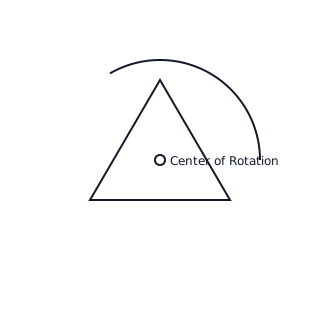
Rotational Symmetry: The number of times a shape fits into itself during a full rotation is called its order of rotational symmetry. An equilateral triangle has an order of 3.
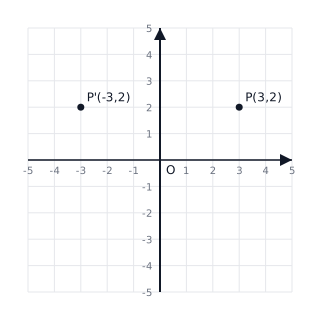
Reflections in the Coordinate Plane: When reflecting in the line , the coordinates map to . Reflecting in the -axis changes the sign of the x-coordinate: .
Rotations on a Grid: A rotation is defined by a center, an angle (, , or ), and a direction (clockwise or anti-clockwise). Points are moved along circular paths around the center.
📐Formulae
Order of Rotational Symmetry (Regular Polygon) = n, where is the number of sides.
Reflection Property: Distance(Object, Mirror Line) = Distance(Image, Mirror Line).
Full Turn = ; Half Turn = ; Quarter Turn = .
💡Examples
Problem 1:
A square is rotated around its center. What is its order of rotational symmetry?
Solution:
Order 4
Explanation:
A square looks identical to its starting position at rotations of , , , and . Since it fits onto itself 4 times in a full circle, the order is 4.
Problem 2:
Reflect the point in the x-axis. What are the coordinates of the image ?
Solution:
Explanation:
When reflecting in the x-axis, the x-coordinate remains the same, but the y-coordinate changes its sign (positive becomes negative) because it moves to the opposite side of the horizontal axis.
Problem 3:
Identify the number of lines of symmetry in a regular pentagon.
Solution:
5
Explanation:
A regular pentagon has 5 equal sides and 5 equal angles. You can draw a line of symmetry from each vertex to the midpoint of the opposite side, resulting in 5 lines.
Problem 4:
Rotate the point by anti-clockwise about the origin .
Solution:
Explanation:
An anti-clockwise rotation of moves a point on the positive x-axis to the positive y-axis. The distance from the origin remains 2 units.
Problem 5:
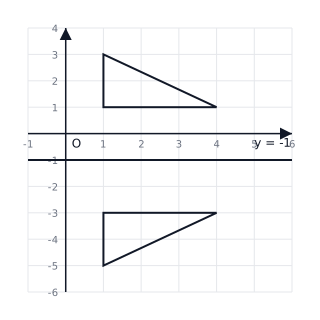
Reflect the triangle with vertices , , and in the line . Find the coordinates of the image triangle .
Solution:
- Identify the distance of each vertex from the mirror line .
- is 2 units above , so is 2 units below: .
- is 2 units above , so is 2 units below: .
- is 4 units above , so is 4 units below: .
The coordinates are , , and .
Explanation:
Reflections preserve the distance of every point from the mirror line. Since the line is horizontal, only the y-coordinates change while x-coordinates remain the same.
Problem 6:
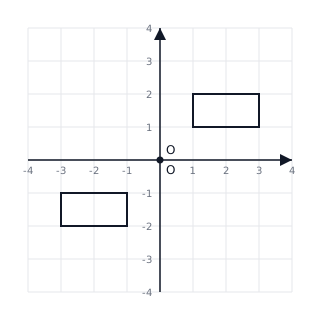
A rectangle has vertices at , , , and . Rotate this rectangle about the origin .
Solution:
A rotation about the origin maps any point to .
The new vertices are , , , and .
Explanation:
A rotation is equivalent to reflecting in the origin. Both the x and y signs are inverted. The shape remains the same size and orientation is inverted.