
Review the key concepts, formulae, and examples before starting your quiz.
🔑Concepts
The coordinate plane is divided into four regions called quadrants by the horizontal -axis and vertical -axis. The origin is where the two axes intersect.
Any point in the plane is represented as an ordered pair . The first number (-coordinate) tells you how far to move left or right, and the second number (-coordinate) tells you how far to move up or down.
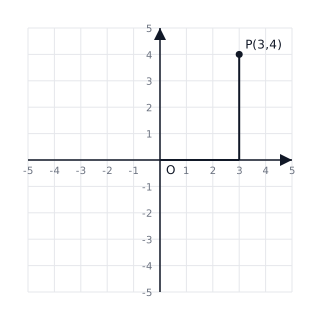
Horizontal distance between two points with the same -coordinate is found using . Similarly, vertical distance is found using when -coordinates are the same.
Geometric shapes can be plotted on the grid. Properties of shapes (like equal side lengths in a square) help determine missing coordinates.
📐Formulae
💡Examples
Problem 1:
Identify which quadrant the point lies in.
Solution:
Quadrant III
Explanation:
In Quadrant III, both the x-coordinate and the y-coordinate are negative. Since -4 and -2 are both negative, the point is in the third quadrant.
Problem 2:
Find the distance between the points and .
Solution:
7 units
Explanation:
Since the y-coordinates are the same (5), the points lie on a horizontal line. The distance is the absolute difference between the x-coordinates: .
Problem 3:
Three vertices of a rectangle are , , and . Find the coordinates of the fourth vertex.
Solution:
Explanation:
In a rectangle, sides are parallel to the axes. The point and form the top side. The point and form the right side. To complete the rectangle, the fourth point must share the x-coordinate of the first point (1) and the y-coordinate of the third point (-3).
Problem 4:
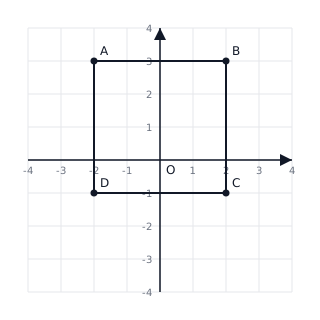
Plot the points , , and . If these are three vertices of a square , find the coordinates of vertex .
Solution:
The coordinates of vertex are .
Explanation:
To form a square, the sides must be equal and perpendicular. Side is horizontal with length . Side is vertical with length . To complete the square, vertex must be units directly below or units to the left of , which leads to .
Problem 5:
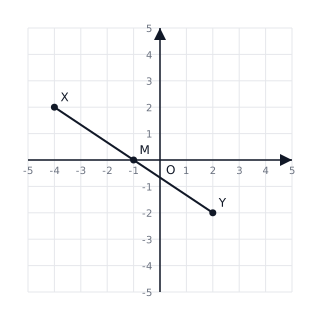
Point is the midpoint of the line segment joining and . Calculate the coordinates of .
Solution:
Explanation:
Use the midpoint formula: . For : . For : .