
Review the key concepts, formulae, and examples before starting your quiz.
🔑Concepts
The fundamental property of any triangle is that the three interior angles always add up to . This rule applies regardless of the triangle's shape or size.
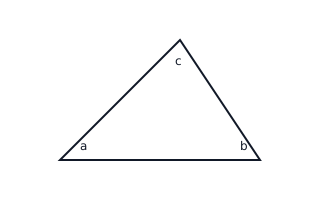
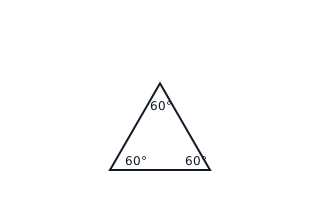
In an Equilateral Triangle, all three sides are equal, which means all three angles are also equal. Each angle measures exactly because .
An Isosceles Triangle has two equal sides and two equal 'base' angles. If you know the vertex angle, you can subtract it from and divide the remainder by to find the base angles.
A Right-Angled Triangle contains one angle that is exactly . The other two acute angles must sum to to make the total .
📐Formulae
💡Examples
Problem 1:
In a triangle, two angles are and . Find the third angle .
Solution:
Explanation:
To find the missing angle, add the known angles: . Subtract this sum from : .
Problem 2:
An isosceles triangle has a vertex angle (the angle between the two equal sides) of . Find the size of the two base angles.
Solution:
each
Explanation:
The sum of all angles is . First, subtract the vertex angle: . Since the two base angles are equal in an isosceles triangle, divide the remainder by 2: .
Problem 3:
One angle of a right-angled triangle is . Calculate the third angle.
Solution:
Explanation:
A right-angled triangle always contains a angle. The sum of the two non-right angles must be . Therefore, .
Problem 4:
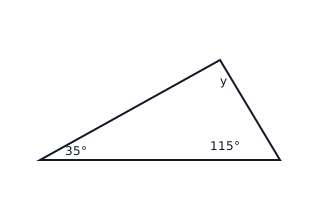
In the triangle shown, find the value of the missing angle . The given angles are and .
Solution:
- Sum of known angles:
- Subtract from total:
Explanation:
Since the sum of angles in a triangle is always , we subtract the sum of the two given angles from to find the remaining angle.
Problem 5:
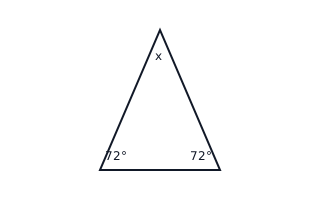
In an isosceles triangle, the two equal base angles are each . Calculate the size of the vertex angle .
Solution:
- Sum of base angles:
- Subtract from total:
Explanation:
In an isosceles triangle, two angles are identical. We add the two equal base angles together and subtract that total from to find the vertex angle.