
Review the key concepts, formulae, and examples before starting your quiz.
🔑Concepts
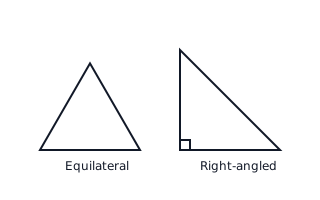
Triangles are classified by their sides: Equilateral (3 equal sides), Isosceles (2 equal sides), and Scalene (no equal sides). They are also classified by their internal angles: Acute (all angles ), Right-angled (one angle ), and Obtuse (one angle ).
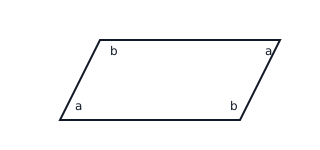
A Parallelogram is a quadrilateral with two pairs of parallel sides. Opposite sides are equal in length, and opposite angles are equal. Consecutive angles are supplementary ().
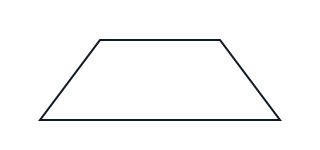
A Trapezium (or Trapezoid) is a quadrilateral with at least one pair of parallel sides. An Isosceles Trapezium has non-parallel sides of equal length and equal base angles.
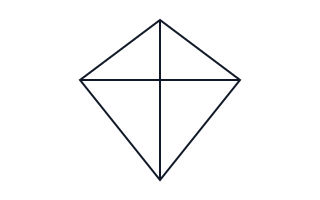
A Kite is a quadrilateral with two pairs of adjacent equal sides. The diagonals intersect at , and one diagonal bisects the other.
📐Formulae
Sum of angles in a triangle:
Sum of angles in a quadrilateral:
Perimeter of a triangle:
Perimeter of a rectangle:
💡Examples
Problem 1:
A triangle has angles measuring and . Find the third angle and classify the triangle by its sides and angles.
Solution:
Third angle = ; Classed as an Acute Isosceles triangle.
Explanation:
To find the third angle: . Since all angles are less than , it is acute. Since two angles are equal ( and ), two sides must be equal, making it isosceles.
Problem 2:
A quadrilateral has four equal sides, but its internal angles are not . Identify the shape.
Solution:
Rhombus
Explanation:
A square and a rhombus both have four equal sides. However, a square must have four angles. If the angles are not right angles, the shape is a rhombus.
Problem 3:
In a quadrilateral , , , and . Find and identify if this could be a parallelogram.
Solution:
; Yes, it is a parallelogram.
Explanation:
Sum of angles = . So, . Since opposite angles are equal (100°=100° and 80°=80°), it satisfies the property of a parallelogram.
Problem 4:
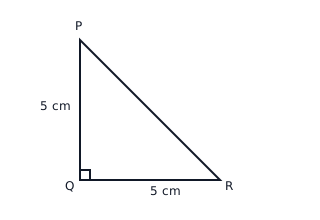
In triangle , side , , and . Calculate the values of the other two angles and classify the triangle by both its sides and its angles.
Solution:
- Since , the triangle is isosceles.
- In an isosceles triangle, angles opposite equal sides are equal. Let .
- Sum of angles: .
- .
- Classification: Isosceles Right-angled triangle.
Explanation:
We use the property that isosceles triangles have two equal base angles and that all angles in a triangle sum to . Because one angle is , it is a right-angled triangle.
Problem 5:
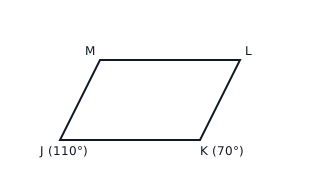
A quadrilateral has and . If side is parallel to and is parallel to , find the measure of and identify the shape.
Solution:
- Since opposite sides are parallel ( and ), the shape is a parallelogram.
- In a parallelogram, opposite angles are equal: .
- Therefore, .
- Also, check . Sum: .
Explanation:
By definition, a quadrilateral with two pairs of parallel sides is a parallelogram. A key property of parallelograms is that opposite angles are congruent.