
Review the key concepts, formulae, and examples before starting your quiz.
🔑Concepts
An acute angle is any angle that measures greater than and less than .
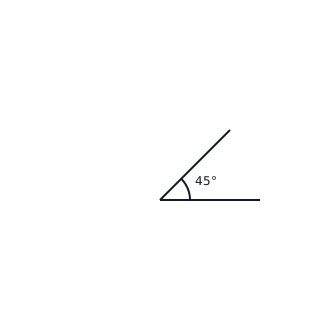
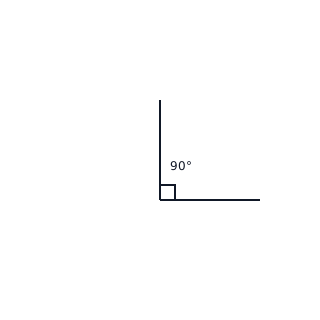
A right angle measures exactly . It is often marked with a small square symbol in the corner.
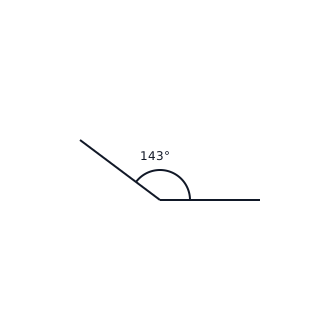
An obtuse angle measures greater than but less than .
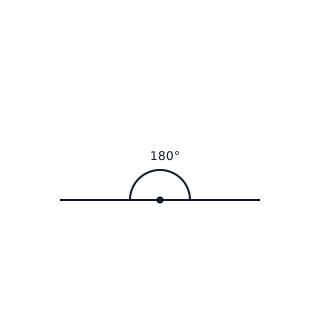
Angles on a straight line always sum to . This is also called a straight angle.
📐Formulae
💡Examples
Problem 1:
Find the missing angle 'x' on a straight line if the other angle is 125°.
Solution:
Explanation:
Since angles on a straight line always sum to 180°, we subtract the known angle from 180° to find the unknown.
Problem 2:
Calculate the reflex angle if the interior (smaller) angle measures 45°.
Solution:
Explanation:
A full turn is 360°. To find the reflex part, we subtract the acute interior angle from the total 360°.
Problem 3:
Identify the type of angle for the following measurements: 92°, 180°, and 210°.
Solution:
92°: Obtuse; 180°: Straight; 210°: Reflex.
Explanation:
92° is greater than 90° but less than 180° (Obtuse). 180° is a flat line (Straight). 210° is greater than 180° but less than 360° (Reflex).
Problem 4:
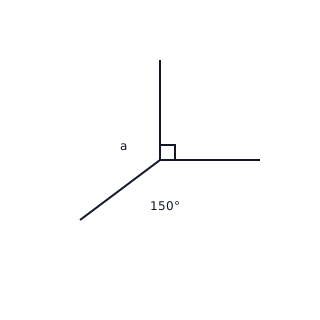
Calculate the missing angle in the diagram, given that the angles are around a point.
Solution:
Explanation:
The sum of all angles meeting at a single point is . By subtracting the known angles ( and ) from , we find the value of .
Problem 5:
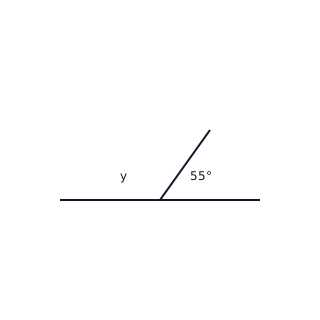
Identify the value of angle on the straight line shown.
Solution:
Explanation:
Angles on a straight line add up to . To find , subtract the given angle from .