
Review the key concepts, formulae, and examples before starting your quiz.
🔑Concepts
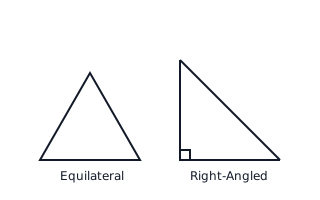
Triangles are classified by their sides into Equilateral (all sides equal), Isosceles (two sides equal), and Scalene (no sides equal). They are also classified by angles into Acute (all angles < ), Right (one angle = ), and Obtuse (one angle > ).
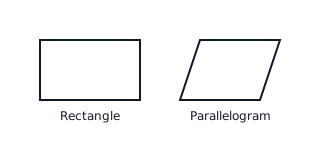
Quadrilaterals are four-sided polygons. Key types include the Parallelogram (opposite sides parallel and equal), Rectangle (parallelogram with four right angles), Square (rectangle with all sides equal), and Rhombus (parallelogram with all sides equal but not necessarily right angles).
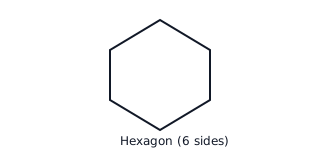
Polygons are closed plane figures made of line segments. A 'Regular Polygon' has all sides and all angles equal. Examples include a pentagon ( sides), hexagon ( sides), and octagon ( sides).
The diagonal of a polygon is a line segment connecting two non-consecutive vertices. In a quadrilateral, there are exactly two diagonals.
📐Formulae
Sum of interior angles of a triangle =
Sum of interior angles of a quadrilateral =
Sum of interior angles of a polygon with sides =
Each interior angle of a regular polygon =
Perimeter of a regular polygon = (where is the length of one side)
💡Examples
Problem 1:
In a triangle , the measure of and . Find the measure of the third angle .
Solution:
- We know that the sum of the angles in a triangle is .
- Therefore, .
- Substitute the given values: .
- Add the known angles: .
- Subtract from both sides: .
Explanation:
This problem uses the Angle Sum Property of Triangles to find an unknown interior angle.
Problem 2:
Calculate the sum of the interior angles of a regular Hexagon.
Solution:
- A hexagon has sides.
- The formula for the sum of interior angles is .
- Substitute into the formula: .
- Calculate the subtraction: .
- Multiply to find the total: .
Explanation:
The sum of interior angles for any polygon depends on the number of triangles it can be divided into, which is .
Problem 3:
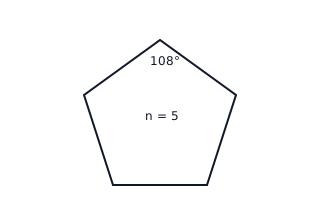
Find the measure of each interior angle of a regular Pentagon.
Solution:
- A pentagon has sides.
- The sum of interior angles is given by .
- Sum .
- For a regular pentagon, each angle .
Explanation:
We use the polygon angle sum formula and divide by the number of vertices since all angles in a regular polygon are equal.
Problem 4:
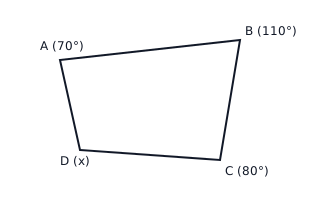
In the given quadrilateral , three angles are , , and . Find the value of the fourth angle .
Solution:
- Sum of interior angles of a quadrilateral .
- Let the angles be .
- .
- .
Explanation:
The sum of all four interior angles in any quadrilateral must equal 360 degrees.