
Review the key concepts, formulae, and examples before starting your quiz.
🔑Concepts
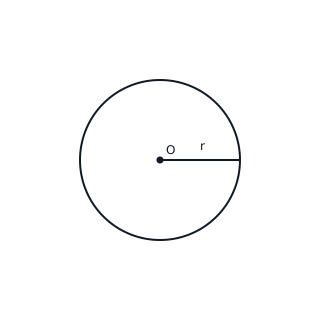
A circle is defined by a center and a radius. Using a compass, keeping the needle at center and the pencil at a distance allows us to draw the set of all points equidistant from .
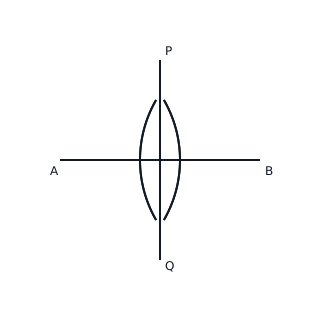
The perpendicular bisector of a line segment is a line that divides into two equal parts at a angle. It is constructed by drawing intersecting arcs of equal radius (greater than half of ) from both points and .
An angle bisector is a ray that divides an angle into two equal parts. To bisect , draw an arc cutting and at and . Then, draw arcs of the same radius from and to intersect at point .
Standard angles like and can be constructed without a protractor. A angle is formed by drawing an arc and then marking the same radius along that arc from the intersection point on the base line.
📐Formulae
💡Examples
Problem 1:
Construct a line segment and find its perpendicular bisector using a ruler and compasses.
Solution:
- Draw a line segment using a ruler. 2. Open the compass to a radius that is clearly more than half of (e.g., ). 3. Place the compass pointer at and draw two arcs, one above the segment and one below. 4. Keeping the same radius, place the pointer at and draw arcs that intersect the previous arcs at points and . 5. Use a ruler to draw a line passing through and .
Explanation:
The line is the perpendicular bisector. It intersects at a point , where and .
Problem 2:
Construct an angle of at the end-point of a ray .
Solution:
- Draw a ray . 2. With as the center and any convenient radius, draw a semi-circular arc that cuts at point . 3. With the same radius and as center, draw an arc cutting the first arc at (this represents ). 4. With as center and the same radius, draw another arc cutting the first arc at (this represents ). 5. From and , draw two arcs with the same radius that intersect each other at point . 6. Join .
Explanation:
The angle is . This method works because is exactly halfway between and ().
Problem 3:
Construct an angle of using a ruler and compasses on a ray .
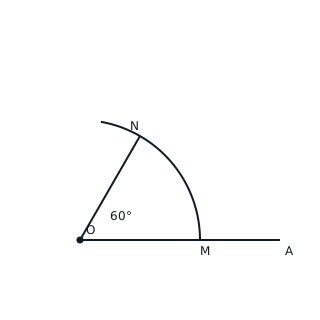
Solution:
- Draw a ray .
- With as center and any convenient radius, draw an arc cutting at point .
- With as center and the same radius, draw another arc intersecting the first arc at point .
- Join and extend it to .
- .
Explanation:
Since the radius used to mark point and point is the same, would form an equilateral triangle if were joined, making the angle at exactly .
Problem 4:
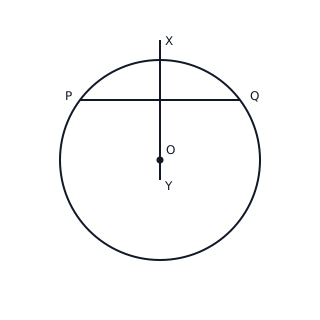
Construct a circle of radius and draw any chord . Construct the perpendicular bisector of .
Solution:
- Mark a point as the center and draw a circle with radius .
- Draw any chord inside the circle.
- With as center and radius , draw arcs above and below .
- With as center and the same radius, draw arcs to intersect the previous arcs at and .
- Join . is the perpendicular bisector of .
Explanation:
The perpendicular bisector of any chord of a circle always passes through the center of the circle.