
Review the key concepts, formulae, and examples before starting your quiz.
🔑Concepts
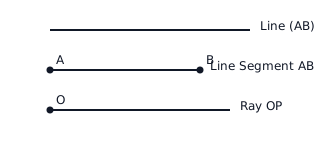
A point indicates a position and has no dimensions, while a line extends infinitely in both directions. A line segment is a fixed portion of a line with two endpoints, and a ray starts at one point and goes on forever in one direction.
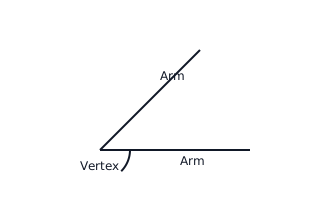
An angle is formed by two rays sharing a common endpoint called the vertex. The rays are the arms of the angle.
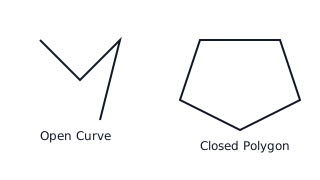
Curves can be open or closed. A simple closed curve that does not cross itself is the basis for defining polygons. A polygon is a closed figure made entirely of line segments.
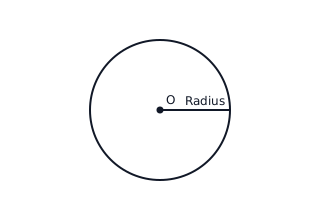
A circle is a simple closed curve where every point on the boundary is at an equal distance (radius) from a fixed center point.
📐Formulae
(Diameter is twice the radius)
(Radius is half the diameter)
💡Examples
Problem 1:
If the radius of a circular wheel is , find the length of its diameter.
Solution:
- Identify the given value: Radius .
- Use the relationship formula: .
- Substitute the value: .
- Calculate the result: .
Explanation:
Since the diameter of any circle is exactly twice the length of its radius, we multiply the given radius by to find the diameter.
Problem 2:
In a quadrilateral , how many diagonals can be drawn? Name them.
Solution:
- A quadrilateral is a polygon with vertices: and .
- Diagonals connect non-adjacent vertices.
- Identify pairs of non-adjacent vertices: and .
- Therefore, there are diagonals: and .
Explanation:
In any polygon, a diagonal is a line segment connecting two corners that are not next to each other. For a four-sided figure, only two such pairs exist.
Problem 3:
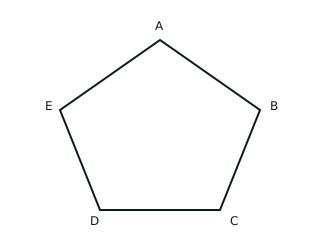
Identify the number of sides and vertices in the given polygon . Also, name any two adjacent sides.
Solution:
- The polygon has sides: , , , , and .
- It has vertices: , , , , and .
- Two adjacent sides are and (they meet at vertex ).
Explanation:
A polygon with five sides is called a pentagon. Adjacent sides are any two sides that share a common endpoint (vertex).
Problem 4:
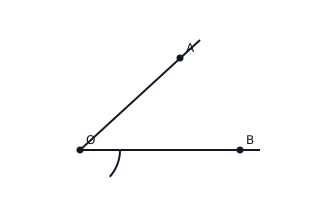
In the following figure, identify the rays and the angle formed at the vertex .
Solution:
- The two rays are and .
- The vertex is .
- The angle formed is or .
Explanation:
Rays start from a fixed point (origin) and extend infinitely. When two rays originate from the same point, the space between them is measured as an angle.