
Review the key concepts, formulae, and examples before starting your quiz.
🔑Concepts
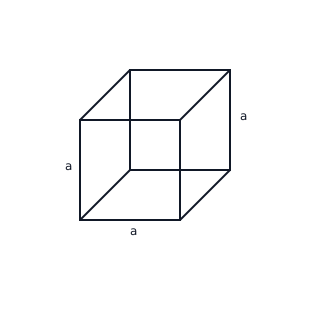
A cube is a three-dimensional solid with six equal square faces. For a cube with edge length , it has 8 vertices, 12 equal edges, and 6 faces.
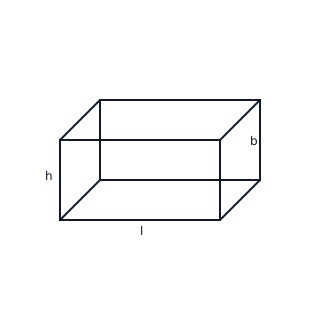
A cuboid (rectangular prism) has 6 rectangular faces. The dimensions are identified as length (), breadth (), and height (). Opposing faces of a cuboid are identical.
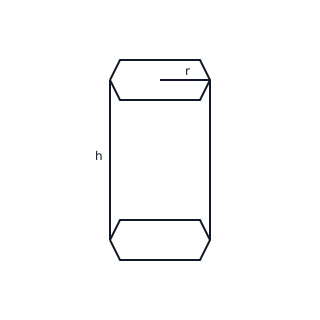
A cylinder consists of two parallel circular bases and a curved surface. The distance between the circular bases is the height () and the radius of the circular base is .
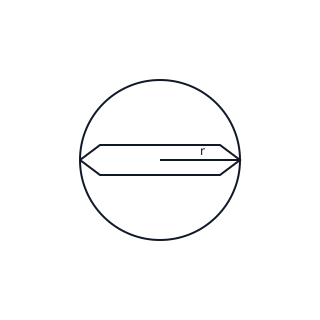
A sphere is a perfectly round 3D object where every point on the surface is at an equal distance (radius ) from the center.
📐Formulae
Volume of a Cuboid =
Total Surface Area (TSA) of a Cuboid =
Volume of a Cube = (where is the side)
Total Surface Area (TSA) of a Cube =
Euler's Formula for Polyhedra:
Diagonal of a Cuboid =
💡Examples
Problem 1:
Find the volume and the total surface area of a cuboid whose length is , breadth is , and height is .
Solution:
Given: , , .
- Volume:
- Total Surface Area:
Explanation:
To find the volume, multiply all three dimensions. For the total surface area, calculate the area of the three pairs of opposite rectangular faces and sum them up.
Problem 2:
A cube has an edge length of . Verify Euler's formula for this shape and calculate its volume.
Solution:
- Identification: A cube has (faces), (vertices), and (edges).
- Euler's Formula Verification: Since the result is , Euler's formula is verified.
- Volume Calculation:
Explanation:
First, identify the number of faces, vertices, and edges for the cube to plug into Euler's formula (). Then, use the side length to find the volume by cubing the side value.
Problem 3:
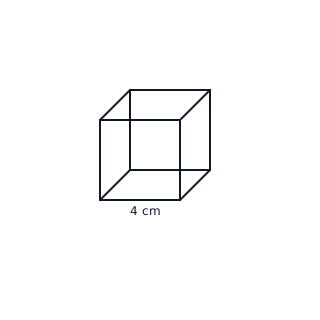
Calculate the Total Surface Area (TSA) of a cube whose edge is . Also, find the area of its four lateral faces.
Solution:
Explanation:
To find the total surface area, we multiply the area of one square face () by the 6 faces. For lateral surface area (excluding top and bottom), we multiply by 4.
Problem 4:
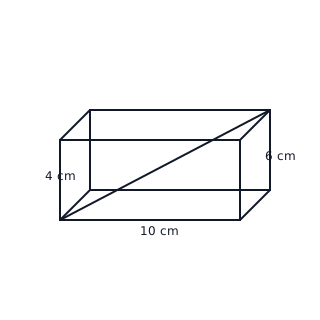
A wooden box is in the shape of a cuboid with length , breadth , and height . Find the length of the longest rod that can be placed inside this box.
Solution:
Explanation:
The longest rod that can fit inside a cuboid is equal to the length of its space diagonal, connecting two opposite vertices.