
Review the key concepts, formulae, and examples before starting your quiz.
🔑Concepts
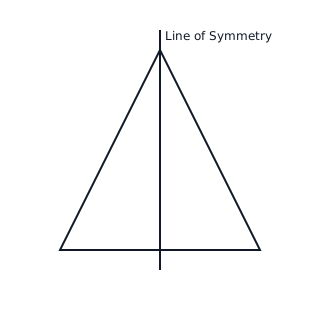
A figure is said to be symmetrical if it can be folded along a line such that the two parts coincide exactly. This line is known as the Line of Symmetry or the Axis of Symmetry. For example, an isosceles triangle has one line of symmetry passing through its vertex perpendicular to the base.
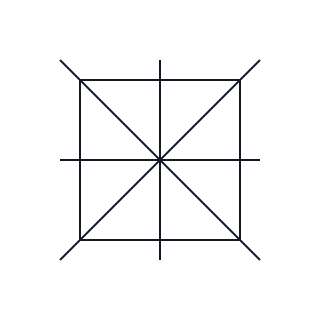
A Regular Polygon (where all sides and angles are equal) has as many lines of symmetry as the number of its sides. For instance, a square has 4 lines of symmetry, while a regular pentagon has 5.
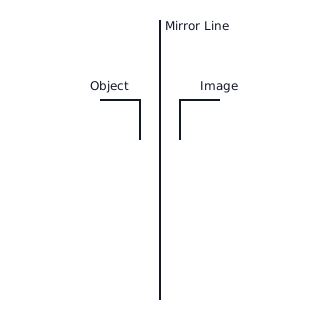
Reflection Symmetry (or Mirror Symmetry) occurs when an object is reflected across a mirror line. The image formed is at the same perpendicular distance from the mirror line as the object, but on the opposite side. Note that reflection causes Lateral Inversion, meaning the left side of the object appears as the right side of the image.
In a coordinate plane, reflecting a point across the -axis changes the sign of the -coordinate, while reflecting across the -axis changes the sign of the -coordinate. The line of reflection acts as the perpendicular bisector of the segment joining the object and the image.
📐Formulae
💡Examples
Problem 1:
Identify the number of lines of symmetry for a rectangle and a circle.
Solution:
- For a rectangle: It has lines of symmetry. These are the lines joining the midpoints of the opposite sides (one vertical and one horizontal). Note that the diagonals of a rectangle are NOT lines of symmetry.
- For a circle: It has an infinite number of lines of symmetry. Any line passing through the center of the circle (the diameter) acts as a line of symmetry.
Explanation:
A line of symmetry must divide the shape into two identical halves that coincide when folded. In a rectangle, folding along a diagonal does not align the corners, so only the lines connecting midpoints work. A circle is perfectly round, so any diameter splits it into two equal semicircles.
Problem 2:
A point is located away from a mirror line . If is the reflected image of , calculate the total distance between the original point and its image .
Solution:
Step 1: Note the distance of the object from the mirror line: . Step 2: Use the property of reflection that the image is at the same distance behind the mirror line as the object is in front of it. Distance of from . Step 3: Calculate total distance . .
Explanation:
The mirror line is the perpendicular bisector of the line segment joining the object and its image. Therefore, the total distance is simply double the distance from the object to the mirror.
Problem 3:
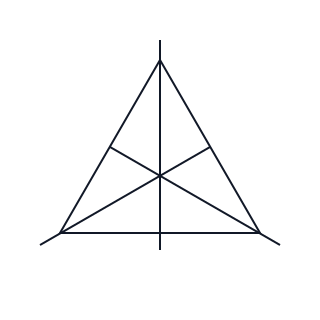
Draw the lines of symmetry for an Equilateral Triangle and state the total number of lines of symmetry.
Solution:
An equilateral triangle has 3 lines of symmetry. Each line passes through a vertex and the midpoint of the opposite side. Total number of lines of symmetry = .
Explanation:
Since an equilateral triangle is a regular polygon with 3 equal sides, it follows the rule that a regular polygon of sides has lines of symmetry.
Problem 4:
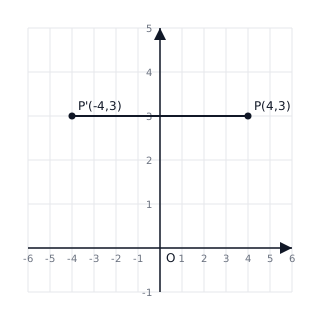
A point is reflected in the -axis to form image . Find the coordinates of and the distance between and the -axis.
Solution:
- Reflection in the -axis changes the sign of the -coordinate: .
- The distance of point from the -axis is the absolute value of its -coordinate: units.
Explanation:
The -axis acts as the mirror line. The perpendicular distance from to the line (the -axis) is units. The image must be units on the other side, at .