
Review the key concepts, formulae, and examples before starting your quiz.
🔑Concepts
A Quadrilateral is a closed polygon with four sides, four vertices, and four angles. The sum of all interior angles is always .
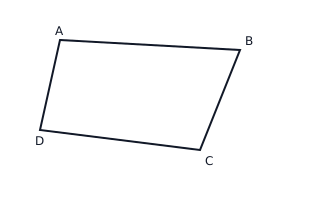
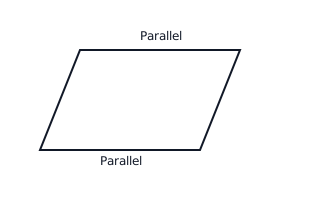
A Parallelogram is a quadrilateral where both pairs of opposite sides are parallel and equal. Opposite angles are also equal.
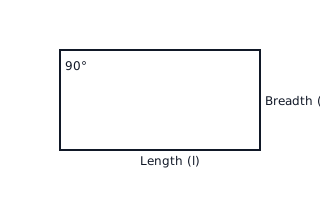
A Rectangle is a special parallelogram where every interior angle is a right angle (). Opposite sides are equal.
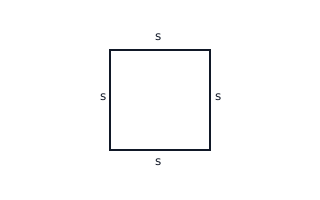
A Square is a quadrilateral with four equal sides and four right angles. It is both a rectangle and a rhombus.
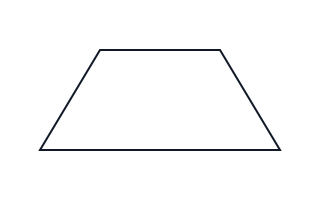
A Trapezium is a quadrilateral with at least one pair of parallel sides.
📐Formulae
Sum of interior angles:
Perimeter of a general Quadrilateral:
Perimeter of a Rectangle: where is length and is breadth
Perimeter of a Square: where is the length of a side
Perimeter of a Rhombus: where is the length of a side
💡Examples
Problem 1:
In a quadrilateral , three angles are measured as , , and . Find the measure of the fourth angle.
Solution:
- Let the fourth angle be .
- According to the angle sum property of a quadrilateral: .
- Substitute the known values: .
- Add the known angles: .
- Subtract from both sides: .
- Therefore, the fourth angle is .
Explanation:
We use the fundamental property that all interior angles of any quadrilateral must add up to exactly to find the unknown value.
Problem 2:
Identify the quadrilateral which has all sides equal in length but does not necessarily have right angles at its vertices. If one side is cm, what is its perimeter?
Solution:
- A quadrilateral with all sides equal is either a square or a rhombus.
- Since the problem states it does not necessarily have right angles, the most accurate name is a Rhombus.
- All sides of a rhombus are equal, so cm.
- Perimeter .
Explanation:
This problem tests the property-based identification of shapes. Since all sides are equal, we use the perimeter formula .
Problem 3:
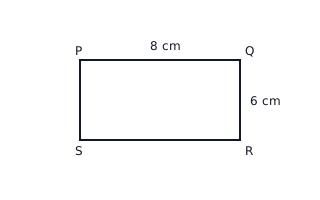
In the given rectangle , if cm and cm, find the lengths of and .
Solution:
In a rectangle, opposite sides are equal. Therefore, cm and cm.
Explanation:
Since is a rectangle, the side opposite to is , making them equal. Similarly, the side opposite to is , making them equal.
Problem 4:
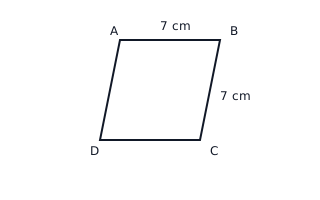
Identify the type of quadrilateral where and , and all sides are equal to cm, but angles are not .
Solution:
- Opposite sides are parallel (, ), so it is a parallelogram.
- All sides are equal ( cm).
- Since all sides are equal and angles are not , the quadrilateral is a Rhombus.
Explanation:
A quadrilateral with two pairs of parallel sides and all four sides of equal length is a Rhombus. If the angles were , it would be a square.