
Understanding Elementary Shapes - Types of Angles (Right, Straight, Acute, Obtuse, Reflex)
Review the key concepts, formulae, and examples before starting your quiz.
🔑Concepts
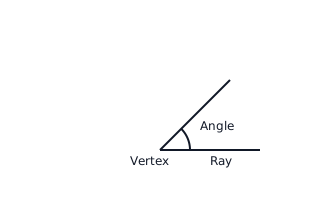
An angle is formed when two rays originate from a common endpoint called the vertex. The standard unit of measurement for an angle is degrees (). One complete revolution of a ray around its vertex represents an angle of .
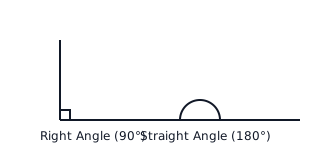
Right Angle and Straight Angle: A right angle measures exactly (one-quarter of a revolution), while a straight angle measures exactly (half of a revolution).
Acute and Obtuse Angles: An angle smaller than a right angle () is called an acute angle. An angle larger than a right angle but smaller than a straight angle (between and ) is called an obtuse angle.
Reflex Angle: An angle which is larger than a straight angle but less than a full revolution (between and ) is called a reflex angle.
📐Formulae
💡Examples
Problem 1:
Classify the following angles based on their magnitudes: (i) (ii) (iii) (iv) .
Solution:
Step 1: is between and , so it is an Acute Angle. Step 2: is between and , so it is a Reflex Angle. Step 3: is exactly a Right Angle. Step 4: is between and , so it is an Obtuse Angle.
Explanation:
To classify angles, we compare the given numerical degree measure against the standard range definitions for acute, right, obtuse, and reflex angles.
Problem 2:
A clock hand moves from to in a clockwise direction. Find the fraction of the revolution it has completed and the name of the angle formed.
Solution:
Step 1: A full revolution covers hours on a clock. Step 2: Moving from to covers hours. Step 3: The fraction of revolution is . Step 4: Calculate the degree measure: . Step 5: Since , the angle is a Reflex Angle.
Explanation:
We first find what part of the total circular path ( hours) the hand has traveled, then convert that fraction into degrees to identify the angle type.
Problem 3:
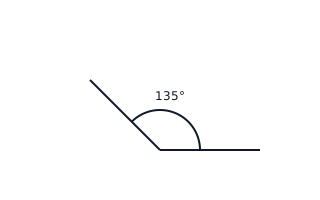
Identify the type of angle shown in the diagram which measures .
Solution:
The angle measures . Since , it is an Obtuse Angle.
Explanation:
Any angle that lies between a right angle () and a straight angle () is classified as obtuse.
Problem 4:
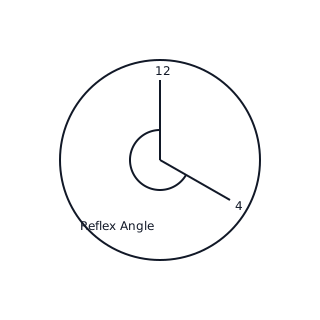
Determine the type of the outer angle formed by the hands of a clock when the time is 4 o'clock, given the interior angle is .
Solution:
The outer angle is . Since , the angle is a Reflex Angle.
Explanation:
A reflex angle represents the larger 'outside' turn between two rays when the interior angle is less than .