
Review the key concepts, formulae, and examples before starting your quiz.
🔑Concepts
An angle is formed by two rays sharing a common endpoint called the vertex. The measure of an angle is typically expressed in degrees (), where a full revolution is divided into equal parts.
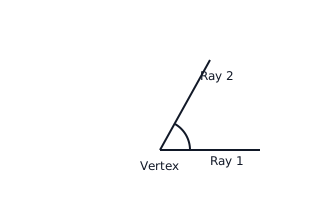
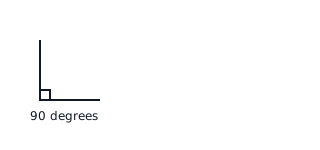
Angles are classified by their measures: An acute angle is less than , a right angle is exactly , and an obtuse angle is greater than but less than .
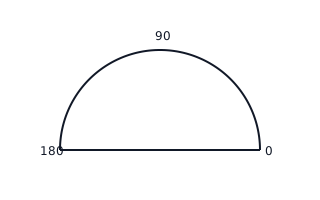
A protractor is the standard tool used to measure angles. It has two scales (inner and outer) marked from to .
A reflex angle is an angle whose measure is greater than but less than . It represents more than a straight line but less than a full circle.
📐Formulae
💡Examples
Problem 1:
What fraction of a clockwise revolution does the hour hand of a clock turn through, when it goes from 3 to 9? Also, find the measure of the angle in degrees.
Solution:
Step 1: Total positions on a clock face = . \nStep 2: Number of positions moved from 3 to 9 = . \nStep 3: Fraction of revolution = . \nStep 4: Angle in degrees = .
Explanation:
Moving from 3 to 9 covers exactly half the clock face, which represents a straight angle or half a revolution.
Problem 2:
Classify the following angles based on their measures: (a) (b) (c) .
Solution:
Step 1: For , since , it is an Acute Angle. \nStep 2: For , since , it is an Obtuse Angle. \nStep 3: For , since , it is a Reflex Angle.
Explanation:
Classification is determined by comparing the given angle measure to the standard benchmarks of and .
Problem 3:
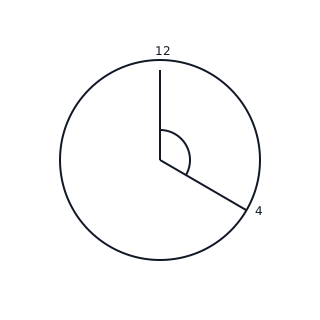
Identify the measure of the angle shown in the diagram and classify it. The angle represents a turn from the o'clock position to the o'clock position on a circular clock face.
Solution:
- A full clock revolution is and is divided into hours.
- Each hour represents .
- From to is hours.
- Measure .
- Since , it is an obtuse angle.
Explanation:
By calculating the angle between the clock hands using the property that each hour mark represents , we find the total degrees and then compare it against angle classification rules.
Problem 4:
Determine the measure of the smaller angle between the north and north-east directions on a compass.
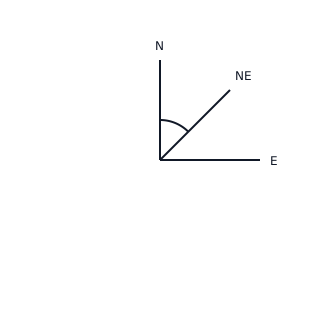
Solution:
- The four main directions (N, E, S, W) divide the circle into equal parts of each.
- North-East (NE) bisects the angle between North and East.
- Angle .
- Since , it is an acute angle.
Explanation:
Since the North and East directions are perpendicular (), the intermediate direction North-East exactly halves that angle.