
Review the key concepts, formulae, and examples before starting your quiz.
🔑Concepts
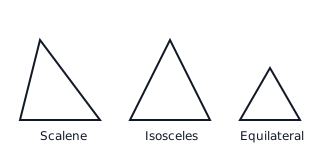
Triangles are classified by their sides into three types: Scalene (no sides equal), Isosceles (at least two sides equal), and Equilateral (all three sides equal).
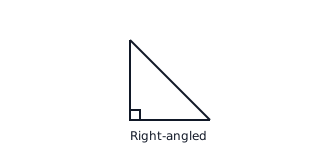
Triangles are classified by their angles: Acute-angled (all angles ), Right-angled (one angle ), and Obtuse-angled (one angle ).
In an Equilateral triangle, all three interior angles are equal and each measures .
The sum of any two sides of a triangle must always be greater than the third side ().
📐Formulae
💡Examples
Problem 1:
In , the angles are and . Find the third angle and classify the triangle by its angles.
Solution:
- Use the Angle Sum Property: . 2. Substitute the known values: . 3. Simplify the sum: . 4. Solve for : .
Explanation:
Since one of the angles () is exactly , the triangle is classified as a Right-angled triangle.
Problem 2:
A triangle has side lengths of , , and . Classify this triangle based on its side lengths.
Solution:
- Observe the lengths of the three sides: , , and . 2. Compare the side lengths: We see that side and side are equal (). 3. Identify that at least two sides are equal.
Explanation:
A triangle with two equal sides is called an Isosceles triangle. Visually, the two sides of would meet at a vertex, creating a symmetrical appearance.
Problem 3:
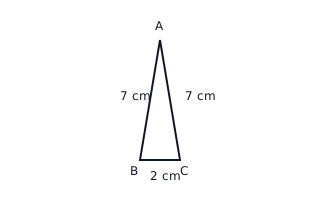
Classify where , , and based on its sides.
Solution:
- Identify side lengths: , , and .
- Observe that two sides ( and ) are equal.
- A triangle with two equal sides is called an Isosceles triangle.
Explanation:
Since , the triangle has two equal sides, making it isosceles.
Problem 4:
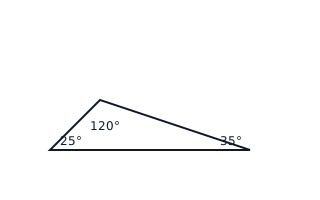
A triangle has angles measuring , , and . Classify this triangle by its angles.
Solution:
- Look at the measure of each angle.
- One angle measures , which is greater than .
- An angle greater than is an obtuse angle.
- Therefore, the triangle is an Obtuse-angled triangle.
Explanation:
If any one angle of a triangle is greater than , the triangle is classified as obtuse-angled.