
Review the key concepts, formulae, and examples before starting your quiz.
🔑Concepts
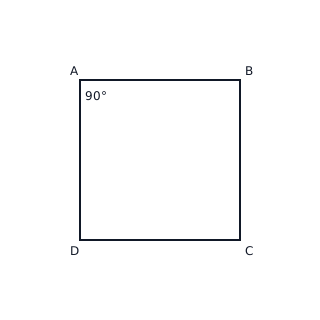
A square is a special quadrilateral where all four sides are equal and all four interior angles are right angles (). The diagonals of a square are also equal and bisect each other at right angles.
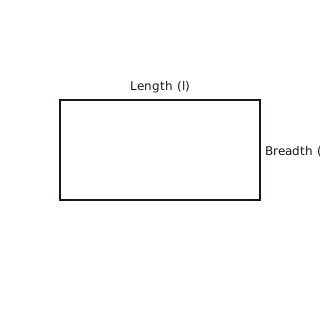
A rectangle is a quadrilateral where opposite sides are equal and parallel. All interior angles are . The longer side is usually called the 'length' and the shorter side the 'breadth'.
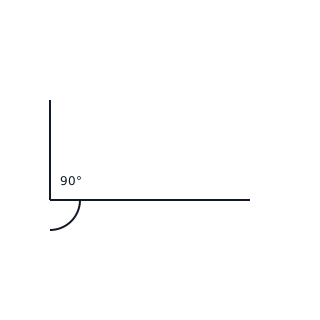
To construct a square or rectangle, we use the property that adjacent sides are perpendicular. We typically draw the base line, construct a angle at the endpoints using a compass or protractor, and then mark the required lengths.
The diagonals of a rectangle are equal in length (). In a square, the diagonals are not only equal but also perpendicular to each other ().
📐Formulae
💡Examples
Problem 1:
Construct a square where each side is .
Solution:
- Draw a line segment .
- At point , construct a ray perpendicular to using a compass ( angle).
- Use the compass to measure and draw an arc from point on ray to mark point .
- From point , draw an arc of radius .
- From point , draw an arc of radius to intersect the previous arc at point .
- Join and .
Explanation:
Since all sides of a square are equal () and all angles are , we ensure the base and height are perpendicular and all segments are exactly long.
Problem 2:
Construct a rectangle with length and breadth .
Solution:
- Draw a line segment .
- At , construct a perpendicular ray .
- With as center and radius , draw an arc cutting at point .
- With as center and radius , draw an arc.
- With as center and radius , draw an arc to intersect the previous arc at point .
- Join and .
Explanation:
In a rectangle, opposite sides are equal. Thus and . The construction uses the property to ensure the shape is rectangular.
Problem 3:
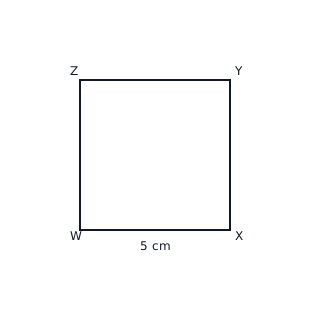
Construct a square with each side measuring .
Solution:
- Draw a line segment .
- At point , construct a ray perpendicular to (making ).
- From point , cut an arc of on ray to mark point .
- At point , construct another ray perpendicular to .
- From point , cut an arc of on ray to mark point .
- Join to complete the square .
Explanation:
Since all sides of a square are equal and all angles are , we use the side length to define all four vertices after establishing right angles at the base.
Problem 4:
Construct a rectangle where the length and breadth .
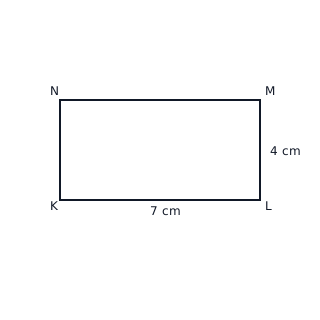
Solution:
- Draw a line segment .
- At point , construct a angle and draw a ray .
- On ray , mark a point such that .
- From point , draw an arc of towards the left.
- From point , draw an arc of upwards to intersect the previous arc at point .
- Join and . is the required rectangle.
Explanation:
Opposite sides of a rectangle are equal ( and ) and all angles are . This construction uses both side measurements and the perpendicular property.